 WESTFIELD, Ind. — In the second installment of Soc Takes TV presented by Sogility, co-hosts Nipun Chopra and Kevin Johnston run the gamut on the Indy Eleven, Indiana men’s soccer, both U.S. national teams, the 2019 Women’s World Cup, Christian Pulisic’s reported move to Chelsea and more. WATCH HERE…
- WESTFIELD, Ind. — Co-hosts Kevin Johnston and Nipun Chopra bring you the first-ever episode of Soc Takes TV presented by Sogility via the ISC Sports Network. Episode 1 covers Manchester United, Borussia Dortmund, Columbus Crew SC, Louisville City FC, Indy Eleven, Butler women’s soccer, Indiana men’s soccer and more….
 Episode 10 of Lower League America focuses on a club dripping with success in the Midwest, Louisville City FC. After first taking the pitch in 2015, the team has already reached the USL Championship summit — and remained there — by hoisting back-to-back titles in 2017 and 2018. Co-hosts…
 Co-hosts Nipun Chopra and Jason Davis are joined by The Athletic’s Miki Turner for Episode 9 of Lower League America. The panel updates the status of all the lawsuits currently hovering over the American soccer landscape. You can watch Episodes 1-8 below: Related: Lower League America: The Premiere Related: Lower League…
 Lower League America returns with Episode 8 covering the USL playoffs, as both the Eastern and Western Conference finals will kick off this weekend. New York Red Bulls II will visit Louisville City FC on Friday night, while Orange County SC will host Phoenix Rising FC on Saturday. The…
 Co-hosts Nipun Chopra and Jason Davis of Compass Football focus on the rapid ascent of FC Cincinnati in Episode 7 of Lower League America. After first taking the pitch in the USL in 2016, the club defied lower-division attendance expectations on its way to getting awarded a spot in…
 Episode 6 of Lower League America with co-hosts Jason Davis and Nipun Chopra covers the phenomenon that is Detroit City FC, one of the most well-supported clubs in all of lower-division American soccer. The main topic of discussion is whether the time is right for Detroit City to make…
 The USL postseason is just around the corner. With this being the final week of the regular season, Cincinnati Soccer Talk (CST) co-hosts Nick Seuberling, Bryan Weigel and Rob Peirce welcome Soc Takes managing editor Kevin Johnston to the show to help size up the playoff race and beyond….
 Episode 5 of Lower League America with co-hosts Nipun Chopra and Jason Davis is here. The fellas discuss the history of the New York Cosmos, one of America’s most storied clubs. They also touch on the USL’s company-wide rebrand announced earlier this week. Related: Lower League America: The Premiere Related: Lower…
 Co-hosts Jason Davis and Nipun Chopra return with Episode 4 of their Lower League America series, this installment entitled “The Good, the Bad, and the Ugly of the USL.” The two discuss the history of the USL and also follow up on Episode 3 with a comment from NASL…
 Lower League America, a collaboration between Compass Football’s Jason Davis and our own Nipun Chopra, returns with a third episode entitled “Live Fast, Die Young – The Story of the New NASL.” The two-man panel breaks down the history of the modern NASL, tracing back the league’s origins before…
 Compass Football‘s Jason Davis and Soc Takes‘ Nipun Chopra link up for the second episode of their new Lower League America series, this one entitled “Big Trouble in Little Chattanooga.” If the title isn’t a big enough hint, they delve into the contentious situation brewing in Chattanooga, Tenn., where…
Month: November 2024
VIDEOS Archives – Soc Takes
 The Soccer Tavern host Dave Knittel discusses the history and evolution of position numbers in soccer. Starting with Herbert Chapman in the 1920s, he then shifts to how numbering evolved with the changing formations over the decades. Follow The Soccer Tavern on Twitter: @TheSoccerTavern. Support Soc Takes on Patreon for…
 The Soccer Tavern‘s Dave Knittel shares soccer’s creation story beginning in the Middle Ages, then moving to 18th-century English public schools and finally discussing the formation of the Football Association (FA) and International Football Association Board (IFAB). Follow The Soccer Tavern on Twitter: @TheSoccerTavern. Support Soc Takes on Patreon…
 We’re extremely pleased to announce that The Soccer Tavern has partnered with us to help expand our video content at SocTakes.com. For the occasion, The Soccer Tavern produced the short video above about our work and staff. Give it a watch to learn more about our website and the…
 INDIANAPOLIS — The ISC Sports Network unveiled its Top 10 Plays of the Year list from the 2018-19 Indiana high school sports season, and some late-game footy heroics at Michael A. Carroll Stadium captured the top spot. Chesterton High School hoisted the IHSAA Class 3A boys state title over…
- INDIANAPOLIS — The two-man panel of Kevin Johnston and Nipun Chopra breaks down the USWNT’s run at the World Cup and ditto for the USMNT at the Concacaf Gold Cup. The fellas then round out Episode 8 of Soc Takes TV presented by Union Jack Pub Broad Ripple on…
- INDIANAPOLIS — A special edition of Soc Takes TV presented by Union Jack Pub Broad Ripple focusing on the U.S. women’s national team’s run at the 2019 World Cup is now available for public consumption on the ISC Sports Network. Also in Episode 7, co-hosts Nipun Chopra and Kevin…
 WESTFIELD, Ind. — Usual suspects Kevin Johnston and Nipun Chopra return to the airwaves with ample U.S. women’s national team, Indy Eleven and FC Cincinnati chatter in Episode 6 of Soc Takes TV presented by Sogility on the ISC Sports Network. WATCH HERE Support Soc Takes on Patreon for…
- WESTFIELD, Ind. — Co-hosts Nipun Chopra and Kevin Johnston ramble on about everything from FC Cincinnati and Indy’s Eleven Park development to the ISC Sports Network‘s sorely lacking hair and makeup budget. It’s the latest edition of Soc Takes TV presented by Sogility. WATCH HERE Support Soc Takes on…
 WESTFIELD, Ind. — Co-hosts Nipun Chopra and Kevin Johnston share their thoughts on the Indy Eleven, FC Cincinnati and Sogility, the soccer-specific training facility where the show is filmed, in Episode 4 of Soc Takes TV on the ISC Sports Network. WATCH HERE Support Soc Takes on Patreon for…
- WESTFIELD, Ind. — Co-hosts Kevin Johnston and Nipun Chopra size up the latest colossal news spewing out of Indy Eleven headquarters before venturing on to national and global soccer in Episode 3 of Soc Takes TV presented by Sogility. WATCH HERE Support Soc Takes on Patreon for access to…
 Chattanooga FC co-founder and president Sheldon Grizzle joins co-hosts Jason Davis and Nipun Chopra to discuss the team’s recent decision to open the club up to fan ownership. The move has already proven wildly successful as the team prepares for its first season in the professional ranks as a…
 Co-hosts Jason Davis and Nipun Chopra take viewer questions in this grab-bag episode of Lower League America, the series’ 11th installment, titled “The Mailbag.” You can watch Episodes 1-10 below: Related: Lower League America: The Premiere Related: Lower League America: Big Trouble in Little Chattanooga Related: Lower League America: Live Fast, Die…
Indiana, St. Louis clash in battle of decorated programs – Soc Takes
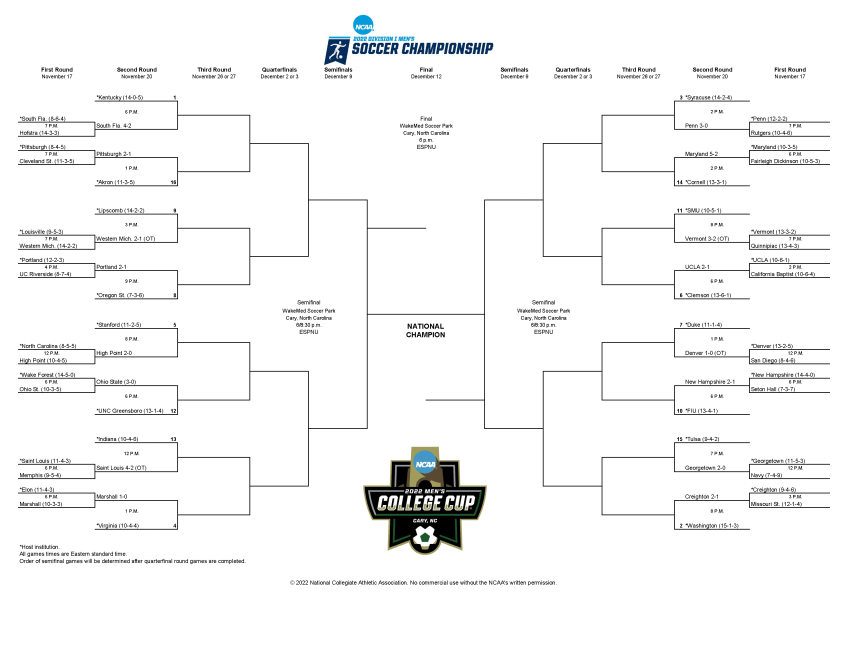 Image credit: NCAA
In 1973, Indiana University’s men’s soccer team played its first NCAA season. The next year, the Hoosiers made their first NCAA Tournament appearance. And now in its 50th year, IU is still going strong getting ready to make their 47th NCAA Tournament appearance when they host St. Louis on Sunday at noon ET.
No. 13 seed Indiana (10-4-6) received a bye for the first round. The Hoosiers most recently took down Penn State (1-0) and Maryland (2-1) en route to the Big Ten championship match. But in the championship, Rutgers took charge from the first whistle, allowing the Hoosiers just one goal and earning a 3-1 result. It marked the first Big Ten championship for the Scarlet Knights since joining the conference in 2014.
Ryan Wittenbrink leads the attack for the Hoosiers with eight goals and eight assists on the season. Tommy Mihalec is next in line with six goals and two assists. Fifteen different players have found the net this season, including nine who have found the net multiple times. So, expect the Hoosiers to be sneaky on the attack. And watch out for Wittenbrink, who is dangerous on set pieces and in the box.
St. Louis (12-4-3) won the Atlantic 10 championship 3-2 on penalty kicks, after posting a 0-0 draw with Loyola Chicago, earning an automatic bid in its 50th Tournament appearance. The Billikens lead the NCAA with 10 national championships. St. Louis has not lost a match since a 3-2 loss at Rhode Island on Oct. 5. The Billikens ended the season on a 6-0-2 run, outscoring opponents 18-4 during that span.
Thursday night, St. Louis and Memphis battled to a 2-2 draw. But in 20 minutes of overtime, the Billikens found the net two more times for a 4-2 win, advancing to the second round of the tournament. Memphis struck first with a 23rd-minute goal. Just before the half, Seth Anderson evened the score. In the 76th minute, Saint Louis took a 2-1 lead when Alberto Suarez netted a penalty kick. But the lead lasted just over three minutes. Memphis sent the game into OT. But goals in the 95th and 108th minutes, respectively, sealed the win for Saint Louis.
John Klein leads the offense with seven goals and five assists, followed closely by CJ Coppola (six goals, one assist) and Alberto Suarez (six goals). Thirteen Billikens have combined for 40 goals this season. Expect plenty of players to step up on offense. Teams that score three goals against St. Louis seem to seal the deal. At least teams that scored three goals resulted in three of the four losses.
The history between these two clubs is storied, to say the least. To reiterate, SLU is making its 50th tournament appearance and has 10 championships. IU is making its 47th and has eight. But St. Louis was well established when IU became an NCAA team. The Billikens won their 10th championship in 1973. They haven’t won one since. IU won its first championship in 1982 and its eighth in 2012. The Hoosiers lead the series with the Billikens 23-9-4, with six-straight wins dating back to 2008.
With the postseason, all records get thrown out the window. The players are told to wipe the slate clean and take it one game at a time. After all, one loss and the season is over.
Rules changes
NCAA postseason matches will not feature golden-goal overtime. If games are tied at the end of 90 minutes, they will play two full overtime periods. If the game is still tied after 20 minutes, they will go to a penalty kick shootout. The NCAA eliminated overtime and PKs for regular-season matches, which is why there are so many ties with the bracket teams.
Teams to keep an eye out for
Ohio State (11-3-5). The Buckeyes surprised Wake Forest (24-6-0) with a 3-0 win Thursday night. Wake Forest was one of only two teams with zero ties in the tournament bracket.
The other team to look out for is High Point University (11-4-5). The Panthers topped UNC 2-0 in round one, winning their first-ever NCAA Tournament game. They’ll play at No. 5 Stanford next.
Follow Kathryn on Twitter: @Katknapp99.
Support Soc Takes on Patreon for access to exclusive content and supporter benefits. Click here to become a patron today.
Related
Brief history of USL – Soc Takes

Photo credit: Robbie Mehling/Soc Takes
With the United Soccer League set to field three separate divisions for the first time since 2009, I think it’s time we talked about the history of the various USL-operated leagues, and of the USL as an organization. Consider this adjacent to my recent “Understanding the pyramid” piece. The USL has a really interesting history and an unlikely origin story, and knowing those can help one to understand the league’s current plans.
The USL actually dates back to 1985, shortly following the demise of the original NASL and the birth of the Major Indoor Soccer League. Francisco Marcos, former vice president of the Tampa Bay Rowdies, Dallas Tornado and Calgary Boomers, founded a development league to the Major Indoor Soccer League known as the Southwest Indoor Soccer League. Five teams contested the inaugural SISL season during the winter of 1986-87, with three based in Texas, one in Albuquerque, and one in Oklahoma City. The league grew to six teams for the following season with the addition of Marcos’ own Austin Sockadillos, and again to nine teams for 1988-89 with the addition of teams in Wichita, San Antonio and Houston.
For the summer of 1989, the league staged an outdoor season as the Southwest Outdoor Soccer League, with six of nine indoor teams participating alongside teams in Denver and Tulsa. Following the successful completion of the 12-game outdoor season, the league rebranded as the Southwest Independent Soccer League for the 1989-90 indoor and 1990 outdoor seasons, reaching 17 teams for the indoor campaign and 14 for the outdoor. The new name lasted a single year, with the league rebranding again to the Sunbelt Independent Soccer League for the 1990-91 indoor and 1991 outdoor seasons following the addition of teams in Arkansas, Georgia and Tennessee. The league continued to grow, fielding 18 teams indoors and 17 outdoors.
The league rebranded yet again, changing names for a third time, to the United States Interregional Soccer League for the 1991-92 indoor season, and continued under this name through the 1994 outdoor season, growing to a truly national footprint and a whopping 69 teams that season. This made the USISL the largest single league to that point in American soccer history.
Following the 1994 outdoor season, the league once again changed its name, becoming the United Systems of Independent Soccer Leagues as the outdoor league by now dwarfed the dwindling indoor league following the collapse of the original Major Indoor Soccer League (known as the Major Soccer League during the ’90-91 and ’91-92 seasons) and declining interest in the indoor game nationally. The existing outdoor league was renamed as the USISL Premier League, alongside a new and fully professional outdoor league known as the USISL Professional League. The new Professional League featured many of the previous top teams among the 55 teams participating that summer, while those that wished to remain semi-pro or amateur formed the 27 teams in the Premier League. The USISL also launched a women’s league known as the W-League, the highest level of women’s club soccer then offered featuring a handful of semi-pro and even professional clubs.
In 1996, the USISL added a third league operating at the same Division 2 level as the American Premier Soccer League, known as the USISL Select League, while the APSL took on the A-League name. These three USISL leagues, alongside the A-League, comprised the entirety of the organized professional system beneath brand-new Major League Soccer. After that season, the A-League and Select League merged to form a USISL-operated Division 2 league under the A-League name. The USISL Professional League, by now operating as Division 3, rebranded as USISL D-3 Pro, and the Premier League rebranded as the Premier Development Soccer League.
The ’97-98 indoor season proved to be the end of USISL indoor play, with only eight clubs entering and only five completing the season. Meanwhile, the W-League split into two tiers for the 1998 season known as W-League W-1 and W-League W-2. This two-tier format lasted through the end of the 2001 season after which the W-League returned to a single-tier format.
The USISL continued to tweak branding, changing its name to the United Soccer Leagues and rebranding the PDSL as the Premier Development League in 1999, and renaming D-3 Pro as USL Pro Soccer for 2003. The league also launched its first dedicated youth league, the USL Super Y-League in 1999, followed by a spun-off dedicated U20 league known as the Super-20 League in 2006.
The next significant branding overhaul came in 2005, with the USL’s top league, the A-League, becoming the USL First Division, and the second third-division USL Pro Soccer league becoming the USL Second Division. These four names lasted through the end of the 2009 season.
During the 2009 season, Nike, which by then owned all of the USL, sold the organization and its six existing leagues to NuRock Soccer Holdings. This led to an internal schism among First Division teams, with several teams allied with Traffic Sports announcing the creation of a new Division 2 league under a reintroduced North American Soccer League brand. This wound up becoming a complicated mess, and rather than go into the necessary depth, I’d like to point you in the direction of the book “Soccerwarz,” written by my friend and Soc Takes contributor Kartik Krishnaiyer.
In a nutshell, U.S. Soccer created new standards for Division 2 and 3 leagues known as the Professional League Standards. For the 2010 season, the USSF also combined the remaining USL First Division teams with the breakaway NASL teams into a one-off league known as the USSF Division 2 Professional League. For 2011, the NASL was to be named as the lone second-division league in the United States, while the remaining USL aligned clubs in the First and Second Divisions would form a new league at the third-division level known as USL Pro. The PDL, W-League and youth leagues would continue to operate as normally.

Photo credit: Robbie Mehling/Soc Takes
USL Pro launched with 15 teams including three in Puerto Rico and one in Antigua and Barbuda. However, only five weeks into the season, the league expelled the three teams from Puerto Rico for, among other reasons, economic issues on the island and medical issues among ownership of two of the three teams. The Antiguan team, Antigua Barracuda FC, was created as essentially a club version of the Antigua and Barbuda national team, due to the island nation advancing to the second round of World Cup qualifying for the first time.
During the winter of 2011, the United Soccer Leagues took control of the third iteration of the Major Indoor Soccer League, restoring professional indoor play to its operations for the first time in 12 years. The USL had previously planned to launch its own professional indoor league, to be known as the USL I-League, but ended up merging its plans into the MISL.
The following season, 11 of the 12 teams returned, with FC New York electing to drop down to the NPSL. Orlando dominated the regular season and finished a whopping 16 points ahead of Rochester in the standings, but lost its first playoff game 4-3 to Wilmington. Wilmington then went on to lose 1-0 to Charleston in the final.
United Soccer Leagues also announced the creation of a women’s youth league, a counterpart to the W-League known as the W-20 League, which would begin in the summer of 2013.
For 2013, two new teams joined the league, Phoenix FC and VSI Tampa Bay. Additionally, this season marked the beginning of USL Pro’s alliance with MLS, with four USL teams affiliating with MLS sides and matches between USL teams and MLS reserves counting in the USL standings. USL also extended the schedule by two games from 24 to 26. After Antigua and Barbuda lost all six games in the third round of World Cup qualifying, support for the USL Barracuda side evaporated. The club was forced to play its entire season on the road in the United States, losing all 26 games and finishing with a -80 goal differential. These records for futility will likely never be matched. At the end of the season, Orlando won its second title in a thrilling 7-4 final victory over the Charlotte Eagles, and was awarded an expansion franchise in MLS for 2015. Meanwhile, VSI Tampa Bay was a flop, averaging fewer than 400 fans per game, folding at season’s end, and Antigua Barracuda never recovered from the loss of federation support, folding as well.
During the winter, the USL-operated MISL played its final season, and following the completion of the indoor season effectively merged with the rival Professional Arena Soccer League. Six of the seven remaining MISL teams joined the PASL, which would rebrand as the Major Arena Soccer League, with the Pennsylvania Roar folding. After only three seasons, the USL was once again without a winter league.
Prior to the 2014 season, USL Pro gained two new expansion teams in Sacramento Republic FC and Oklahoma City Energy FC. The OKC announcement was particularly controversial at the time, given the announcement of an OKC team joining the NASL for 2015 had taken place just weeks prior. The USL once again extended the schedule by two games to 28. Additionally, the Phoenix FC franchise was revoked by the league and immediately flipped to new investors as Arizona United SC, and the first MLS-operated reserve team, LA Galaxy II, joined the league. This season also marked the end of the MLS Reserve League and led directly to the eventual rise of additional MLS-operated teams over the following seasons. Orlando once again finished atop the standings but went out in the first round of the playoffs to end its time in USL Pro, while Sacramento finished in second in its inaugural season and won the championship 2-0 over Harrisburg.
During the offseason, the league rebranded as the United Soccer League, dropping the “Pro” portion of its name. The league also grew dramatically, gaining four new expansion teams in Austin, Colorado Springs, St. Louis and Tulsa, along with seven MLS-operated reserve sides. Two founding members, the Charlotte Eagles and Dayton Dutch Lions, chose to drop to the PDL. Orlando, meanwhile, sold its franchise to Louisville to create Louisville City FC, and the Eagles sold their franchise to create the Charlotte Independence. This left the league with 24 teams for 2015, leading to the implementation of Eastern and Western Conferences. The mass influx of MLS reserve sides led to a debate over whether or not these teams belonged in the professional system that still continues to this day. Rochester finished the season with the best record in the league and won the championship in extra time 2-1 over LA Galaxy II.
Following the completion of the 2015 season, both USL women’s leagues, the W-League and W-20 League, folded, with six teams forming United Women’s Soccer and seven joining the Women’s Premier Soccer League. The USL also folded the Super-20 League and modified the Super Y-League rules to include up to six U-19 players in the U-17/18 bracket. This left the USL in charge of only three leagues, the fewest since 1994.
For the 2016 season, the USL extended the schedule for the first time since 2014, with teams now playing a 30-game season. Six new teams were announced, with San Antonio FC and FC Cincinnati joining as expansion sides alongside four more MLS reserve teams. The Austin Aztex, meanwhile, went on hiatus due to ongoing stadium issues. This left the league with 29 teams to contest the season. The biggest story during the season were comments made by Arizona United owner Kyle Eng in support of Donald Trump in the lead up to the 2016 election, which was followed shortly thereafter by the sale of the team. New York Red Bulls II dominated the regular season and won the championship 5-1 over the Swope Park Rangers, with only one independent team making the semifinals. Cincinnati, meanwhile, absolutely shattered Orlando’s attendance record, drawing over 30,000 fans for its first-round playoff game.
During the winter of 2016, the USL applied for Division 2 status with U.S. Soccer and was granted provisional status to operate at the D2 level alongside the NASL. Two teams, the Ottawa Fury and Tampa Bay Rowdies, defected to the USL from the NASL, joining a lone expansion team in Reno 1868 FC. The new owners of Arizona United rebranded the team as Phoenix Rising FC, and FC Montreal, the reserve side of the Montreal Impact, was folded following a depressing season on and off the field. The USL also finally eliminated a longstanding rule permitting five substitutions per game, put in place due to fixture congestion, and instead adopted the standard three substitutions policy. FC Cincinnati continued to set attendance records during the season amid its bid for an MLS expansion franchise, and managed to defeat the Chicago Fire in the Open Cup in front of over 32,000 fans. Louisville City finished the season as champions, handing the Swope Park Rangers their second-consecutive championship final loss and preventing back-to-back reserve team champions.
- Related: USL announces new brands for 3 leagues
This brings us to 2018. During the offseason, the NASL lost its Division 2 sanctioning, leaving the USL as the lone professional league beneath MLS, and two more NASL teams joined the USL, the Indy Eleven and North Carolina FC. The Harrisburg City Islanders were sold to Rush Soccer and rebranded as Penn FC. Four more expansion teams joined in Fresno, Las Vegas, Nashville and Atlanta’s reserve side, while the Whitecaps elected to fold their USL team. Rochester and Orlando City B both took the season off. The 2018 season will be the last one for FC Cincinnati, with the team joining MLS in 2019. Nashville, meanwhile, will play just one season more before also joining MLS in 2020.
In 2018, the USL announced the creation of a new Division 3 league, filling the gap left by the USL’s acquisition of Division 2 status, alongside a comprehensive rebrand. The top D2 league in the USL will be known as the USL Championship in 2019, with the D3 league known as USL League One, and the PDL as USL League Two. The USL has announced seven expansion teams joining the USL Championship for 2019 in Austin, Birmingham, El Paso, Hartford, Loudoun, Memphis and New Mexico.
USL League One will begin in 2019 with new teams in Greenville, Madison, and Chattanooga, alongside former PDL teams from Tucson and Statesboro. Two teams participating in the 2018 USL season, Toronto FC II and the Richmond Kickers, will also join League One next season, with Orlando City B set to end its hiatus. Penn FC will take the 2019 season off and Rochester plans to extend its hiatus, with both teams joining League One in 2020.
From there, the most distant plans we know about currently include teams joining the USL Championship in 2021 in Chicago and Oakland, and FC Dallas planning to launch a League One team at some point in the near future. Everything else is just rumor and speculation.
Follow John on Twitter: @JohnMLTX.
Support Soc Takes on Patreon for access to exclusive content and supporter benefits. Click here to become a patron today.
Related
Kathryn Knapp, Author at Soc Takes
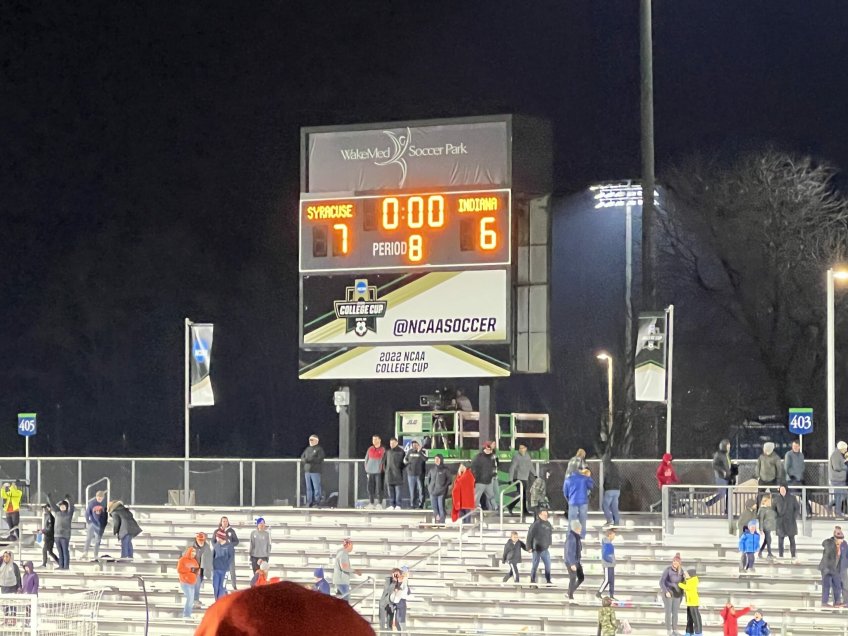 CARY, N.C. — In their 50th season, the Indiana University men’s soccer team was 90 minutes away from the perfect ending to the season — a ninth national championship. The Hoosiers threw everything they had at the Syracuse Orange, fighting back twice to even the score and then heading to…
 Anyone who watched the Indiana Hoosiers men’s soccer team this season had their doubts. The Hoosiers would come together and play great one minute. And 10-15 minutes later, it was a different story. People mumbled in the stands about a different lineup every game. A lot of players saw…
 Soccer. It’s a funny game. You can play your best for 90 minutes and still come up short. Some call it luck. Some call it persistence. Some call it a group of talented individuals coming together and earning a win. Sunday evening, the IU men’s soccer team did just…
 BLOOMINGTON, Ind. — One player doesn’t win a game. But special players make special plays. And special plays win games. Sunday, Indiana’s Ryan Wittenbrink remained calm, cool and collected, sending corner kicks on target and looking for a window. In the 75th minute, a small window opened and he took…
- In 1973, Indiana University’s men’s soccer team played its first NCAA season. The next year, the Hoosiers made their first NCAA Tournament appearance. And now in its 50th year, IU is still going strong getting ready to make their 47th NCAA Tournament appearance when they host St. Louis on Sunday at…
 Younes Dayekh. Remember that name. For college soccer teammates at Bradley, St. Mary’s College and Illinois-Chicago (UIC), they know that name all too well. He’s the one they can count on to bring his A game both on and off the field. He has an infectious smile, is full…
 Soccer fans in Chicagoland — there’s a new team in town. Chicago House AC kicks off its inaugural home season Saturday at SeatGeek Stadium in Bridgeview at 7:35 p.m. CT. The club enters the match with a 1-1 record, and is fresh off a 1-0 win over Stumptown AC….
 Relentless. I look back on last Monday’s national championship between Indiana and Marshall and that’s the word that comes to mind. Marshall was relentless in their attack. They dominated the ball. They shut down the Hoosiers offense. And yet, IU’s players didn’t give up kicking and screaming. They fought…
 For Indiana, the mission was simple — win and advance. The quest for their ninth NCAA championship was on the line. They had to shut down an explosive Pittsburgh offense. If they could control Pitt, they could control the game. It wasn’t easy, but Friday night the Hoosiers relied…
 Lucky No. 21. Could this trip to the men’s College Cup be Indiana’s ticket to its ninth NCAA Championship? It very well could be. In a world where the NCAA couldn’t even confirm whether a championship would happen, the Hoosiers kept focused. They trained via video chats. The players…
 Major League Soccer announced “The 25 Greatest” last week, its 25 greatest players of all time in celebration of its 25th season. Most of the players deserve to be on the list. One of them caught my attention. And I’m having trouble rationalizing it. David Beckham. No disrespect to Beckham….
 Every generation has one: a player who stands above all others; a player who people come to see; a player who is more than just a player. In the late 1980s, Ken Snow was that player for Indiana men’s soccer. Kenny, as those who knew him called him, was…
Mon Goals Podcast, Soc Takes Pod team up to preview #PGHvIND – Soc Takes

Image credit: Mon Goals Podcast
The Mon Goals Podcast, a fellow member of the Beautiful Game Network, welcomes the Soc Takes Pod to the show to help preview Friday’s Pittsburgh Riverhounds SC vs. Indy Eleven match set for 7 p.m. ET at Highmark Stadium.
Host Justin Ashcraft and guest Kevin Johnston break down what to expect from both sides, as the Riverhounds will look to remain the USL’s only unbeaten team. And the Eleven are undefeated on the road. Pittsburgh currently sits in third place in the Eastern Conference, while Indy’s in sixth. Listen:
Support Soc Takes on Patreon for access to exclusive content and supporter benefits. Click here to become a patron today.
Related
Philadelphia Fury players yet to be paid – Soc Takes
 Image credit: Philadelphia Fury
Philadelphia Fury players have not received their paychecks yet, per sources with direct knowledge of the situation. The players were expecting to be paid on Aug. 31, and it is not clear when they will receive them.
The Philadelphia Fury are a founding member of the new Division III-sanctioned National Independent Soccer Association (NISA). Soc Takes reached out to NISA commissioner John Prutch for comment.
Per Jonathan Tannenwald’s reporting, the Philadelphia Fury’s total payroll is expected to be in the “high six figures.”
The Fury are expected to kick off their NISA season against Stumptown Athletic on Sept. 7. Soc Takes also reached out to Fury CEO Matt Driver for comment.
Update: Soc Takes’ multiple attempts to reach the club proved unsuccessful. However, Driver responded to Tannenwald, and the latter paraphrased Driver’s comments on the matter in a tweet:
“Just got off the phone with Matt Driver. All the Fury players have been paid. Driver said there were a few tax/bank/etc. paperwork issues with some players but they’ve been settled at this point.”
Follow Nipun on Twitter: @NipunChopra7.
Support Soc Takes on Patreon for access to exclusive content and supporter benefits. Click here to become a patron today.
Related
Players allege poor treatment at Hartford Athletic – Soc Takes
 Hartford Athletic opens Dillon Stadium on July 13 with a 2-1 win over the Indy Eleven. Photo credit: Robbie Mehling/Soc Takes
The lower divisions of professional soccer can be an unforgiving place for owners. As Soc Takes has discussed before, owners constantly lose money in the pro leagues, and it doesn’t seem as though that will change anytime soon. Unfortunately, it is usually the players and staff who often face the brunt of cost-cutting measures. Occasionally, those owners’ decisions are clearly unfair to players. More often than not, owners manage to stay within the parameters of contractual obligations, but their handling of players/staff remains remarkably poor. Per information provided to Soc Takes, Hartford Athletic is an example of such a club, and Bruce Mandell an example of such an owner.
There are a myriad of allegations shared by club personnel regarding questionable practices by Mandell. Herein we report a subset; the ones we could corroborate from three or more independent sources.
- Related: USL franchise fee rises to $10 million
In all cases, Hartford Athletic declined to make Mandell available or comment on the story.
- Postseason friendlies: The club organized friendlies during the postseason, an unusual practice as players risk injury in meaningless games. The club gave players an option — via an email seen by Soc Takes — to forego the friendlies (termed as “club-directed activities”) in exchange for losing their last month of pay. Players communicating with Soc Takes shared that they feared injury in meaningless games that could impact new contracts for the 2020 season. The team plays a friendly against Portmore United this week.
- Meals: The club provided breakfast and lunch to players from February to May. After May, the club cut down on the number of times it provided lunch. In recent months, the club stopped providing lunch at all. As a comparison, Soc Takes confirmed with players at two other USL clubs that they are provided meals before and after training.
- Per diem reduction: Per the standard USL player contract, players must be provided a per diem during away matches. In lieu of a per diem, multiple players claim that they were given a flat $50 for a weekend, requiring players to purchase six to seven meals with that money. Soc Takes understands that other USL Championship clubs provide higher per diems, plus they often provide players with meals before/after games.
- Low salaries: Sources suggest that the highest annual salary for a player at Hartford Athletic is $44,000 and many players are making below $20,000. There is at least one player making $500 per month. Soc Takes confirmed that a player was signed on a $0 “incentivized contract,” on which he played for two months. After those two months, he was awarded a professional contract. A source with knowledge of contracts informed Soc Takes that the average salary for players at Hartford for the 2019 season was $17,000-$22,000.
- Prevention of additional income. Unlike other players around the league who have side hustles such as coaching or other jobs to make additional income, the club forbids its players from having any part-time jobs, despite their low salaries. Soc Takes was provided documentation that confirmed Mandell prohibited player requests to avail themselves of coaching opportunities in order to make extra money.
- Questionable approach to health-related decisions: Multiple players allege that Mandell intervened to prevent injured players from obtaining MRIs, chiropractic services and counseling. Multiple players corroborated this allegation. One player, Tyler David, shared his story which was not a direct corroboration of this allegation. David suffered a hip injury midway through the season. “I was waiting four weeks to get an MRI. Worker’s compensation company told me they weren’t being sent any request for an MRI from the club, so I didn’t get an MRI until later. I later found out that that I had a complete adductor tear and had to get a surgery two weeks later.” David reiterated that he does not know whether the delay was an insurance company error or team error.
- Unfair player fine: Early during the 2019 season, Mandell attempted to fine a player a week’s wages while the player was away from the club for the birth of his child. This was in spite of the fact that a clause was inserted into the player’s contract, specifying that he was to leave mid-August for the birth of his child, and that the club would pay for his flight. Soc Takes reached out to the player for comment and none was received.
- A potential transfer of an injured player: In September, OKC Energy approached Hartford Athletic to transfer a player who they did not know was injured (and would eventually need surgery). Athletic technical adviser, Paul Buckle, approached the player to determine if the player would be interested in a transfer to Energy. The player refused the transfer, and the transfer conversation ended. Soc Takes reached out to the player and the Energy to confirm. No comment was received at the time of publishing.
It is important to note that Mandell has never missed payroll and has seemingly met all the basic requirements of the USL player contract. However, given the multitude of complaints of mistreatment, the question must be raised of whether the ownership is doing right by its players.
* * *
Danish defender Nikolaj Lyngo signed for Hartford Athletic in early 2019 after having been trained as a youth player at Danish giants Aalborg. The player was omnipresent for the first three months of a difficult on-field season for the Athletic, during which he experienced some well-noted struggles. In early July 2019, the club informed Lyngo that he had two options: “I (had) the opportunity to stay at the club the rest of the contract or (go) home, with them paying for my flight ticket,” Lyngo told Soc Takes. Lyngo chose the latter option and estimated that he lost out on around $12,000 on his contract. When asked why he didn’t stay at the club and simply collect wages, Lyngo said, “Didn’t feel like (I was) wanted after the situation.”
Lyngo’s story is illustrative of Mandell’s handling of the club. It must be recognized that since Lyngo chose to leave the club, this would count as a mutual termination of his contract, and therefore would not be illegal. Some might even applaud Mandell for giving Lyngo agency — that he could decide his fate for himself. However, did Mandell utilize a heavily skewed power dynamic to get a young, possibly contract-negotiation-naive player off his books? Is there truly a choice between immediately going home to your family or sticking it out in a new country, without professional or personal support?
* * *
Soc Takes learned that Hartford Athletic players reached out to the USL Players Association (USLPA) to record concerns about Mandell’s handling of some of the aforementioned issues. In response to a request for comment, USLPA spokesperson Steve Gans said:
“A few Hartford Athletic players did reach out to player leadership of the USLPA on a couple of matters; I’m not going to go into what those are specifically. But, they (the unspecified issues) show why this comprehensive CBA (collective bargaining agreement) is needed, because there will be uniform standards and best practices throughout the league. Right now because it isn’t in place, it allows for a great variety for what one team might provide versus another team.”
A player told Soc Takes about Mandell, “It’s a shame that the conditions are the way that they are because there’s so much potential in Hartford and we have a great fan base. But one person leaves a sour taste in your mouth and ruins the whole thing.”
Mandell (and arguably other owners) are able to easily traverse this line between proper and improper because currently the line is infinitely thick. In the absence of a standard for things like per diem, salary, etc., players will continue to suffer the brunt of cost-cutting measures. In an environment of low salaries with few jobs at the top level, players are required to put up or shut up. Hartford Athletic reinforces that the USLPA is needed.
Hartford Athletic also raises a very important unanswered question: How many of these stories are there in lower-division American soccer?
Soc Takes reached out to the USL for comment over 24 hours before the publishing of this article.
WRALSportsFan.com’s Neil Morris contributed to the editing of this story.
On October 27th, #8 was clarified based on sources who reached out to Soc Takes after the publishing of the article.
Follow Nipun on Twitter: @NipunChopra7.
Support Soc Takes on Patreon for access to exclusive content and supporter benefits. Click here to become a patron today.
Related
Opinion: USL should force Independence owner to sell team – Soc Takes
An ongoing history of bigoted posts from majority owner Dan DiMicco necessitates a response from the league
 The Charlotte Independence pose for a group photo ahead of a 2018 USL fixture. Photo credit: Robbie Mehling/Soc Takes
Racism and bigotry have no place in sports or sports ownership, let’s just start there. It should go without saying, but as with many seemingly obvious things, it unfortunately needs repeating every so often.
Many leagues have learned this lesson and follow it. Owners have been forced to sell teams in the NBA, NFL, MLB and NHL due to bigotry, personal conduct and other controversies. Probably one of the most notable examples revolving around bigotry and racism came on April 29, 2014, as NBA Commissioner Adam Silver banned former LA Clippers owner Donald Sterling from the league for life, with the league ultimately terminating his ownership and forcing a sale of the team.
Unfortunately, it appears to be time for another reminder of this incredibly obvious lesson, this time in the realm of soccer in the USL Championship. Daniel Ralph DiMicco bought majority ownership of the Charlotte Independence in January 2018. His arrival was heralded by current president Jim McPhilliamy at the time of the sale as “a great addition to our investor group” in a call to the Charlotte Observer.
“He invested in the team last year and has become very passionate about the team from both a competitive and business perspective. He’s furthered his involvement to help us move our vision for the team forward. Plus, he’s a really good guy,” McPhilliamy said in that 2018 interview.
Fast-forward to two years later in mid-2020, at a time when many ugly facets of society — steeped in a long history of racism and bigotry — are coming more into the light of day and are being rightfully challenged. DiMicco still owns a controlling interest in the Independence, but fans of the club are making it known that DiMicco’s very public-facing statements on platforms such as Twitter are completely unacceptable.
A quick perusal of DiMicco’s feed — rife with far-right political conspiracies, anti-Chinese sentiment and perpetuating claims that racism doesn’t exist today — does not take long to reveal multiple problematic messages, clearly indicative of DiMicco’s personal views and politics.
A quick example of four of these recent posts and retweets is enough to put DiMicco in Donald Sterling territory:


In just the past few days, DiMicco has claimed racism doesn’t exist and it’s only pretended to continue to exist to control Black people. He has parroted President Trump’s racially-charged “Chinese Virus” name for the coronavirus pandemic. He has even compared the Chinese government to Nazi Germany, calling the pandemic a crime committed by “CCP China.” Diving back further in his timeline reveals that these types of posts have been going on for a long, long time.
These sentiments ought to have no place in U.S. sports ownership. No league should tolerate one of the representatives of their organization vocalizing such vile, disgusting, bigoted ideals. The very fact that these exist begs the question: Why has the USL not stepped in and addressed these problematic comments from the owner of one of its clubs? Why does the league do business and collect franchise fees from someone like this? How has DiMicco not been forced to sell this team? Independence fans have noticed the comments and have been vocal in their criticisms of DiMicco and of the team and league’s silence:
But those friends & family don’t tweet disinformation about COVID and the Black Lives Matter movement to thousands of followers. Turning a blind eye to this, as the club seems to be doing, is supporting it.
— Chris Davis 😷 (@ThatChrisDavis) June 26, 2020
So to me, contributing any money to a club with a majority owner who conducts himself this way is just morally wrong. I love this club, but until there are meaningful changes, @sango14748 & I will no longer be supporting the Charlotte Independence.
— Chris Davis 😷 (@ThatChrisDavis) June 26, 2020
Remember how the NBA got Donald Sterling outa here when his racism was too public to hide, @USLChampionship owners/execs, time for yall to do the same with @Independence’s @DanRDimicco. His promoted hate against LGBTQ, Black people, & other marginalized communities is sick. #USL
— Jason W (@HomeSweetSoccer) June 29, 2020
The fact is that each of these comments individually takes DiMicco to the level of a Donald Sterling situation. Together, they represent a pattern of bigoted thinking that DiMicco is completely unafraid to vocalize publicly. Tweets such as the ones displayed here are put out by DiMicco hourly, his timeline densely populated by exactly this kind of attitude.
This isn’t one single mistaken tweet that can be apologized for. The views expressed by DiMicco have no place in modern society and must be addressed by the organization responsible for doing business with him. The USL must take action on this incredibly problematic individual or it will be complicit in allowing him to profit off of their structure while they remain silent.
The league has a chance to be better, just as Adam Silver showed the NBA to be when he took one of the harshest actions against an owner in one of the most powerful sports leagues worldwide. Even if they don’t, with so many Independence fans refusing to support DiMicco and the oncoming presence of an MLS club in the city, DiMicco’s views — if they’re allowed to remain — could very well be the final nail in the coffin for the club’s long-term future.
Follow Colton on Twitter: @cjcoreschi.
Support Soc Takes on Patreon for access to exclusive content and supporter benefits. Click here to become a patron today.
Related
Preki expected to be head coach of Cal United FC – Soc Takes

Preki (Photo credit: MLS)
Soc Takes has learned that Predrag Radosavljević (Preki) is poised to take over as the first head coach of Cal United FC. The nascent club, at present poised to play in the NASL in 2018, was initially expected to begin the season with Eric Wynalda at the helm. Recently, Wynalda declared his interest in running for the post of US Soccer president.
Soc Takes understands Wynalda will continue to serve as the technical director of the Orange County club.
Preki has previously coached at Toronto FC and famously lead Sacramento Republic to USL silverware in 2014. During the 2017 season, the no-nonsense head coach was with St Louis FC. Preki’s move is expected to be the start of a managerial merry-go-round involving Marc dos Santos, Gio Savarese, etc.
A spokesperson for Cal United FC responded to Soc Takes’ request for comment on the story:
“We don’t have any information to share with you at this time.”
Soc Takes understands Cal United FC has had preliminary conversations with marquee NASL and USL strikers to bring them to the club.
Barring any last minute hiccups, Preki will start the 2018 season with Cal United FC; whether that will be in the NASL or USL remains unclear.
Follow Nipun on Twitter: @NipunChopra7.
Support Soc Takes on Patreon for access to patron-only Soc Takes Pod episodes, exclusive written content and tier rewards. Click here to become a patron today.