Tyler Pasher to remain in Eleven midfield? – Soc Takes

Photo credit: Robbie Mehling/Soc Takes

INDIANAPOLIS — For versatile Indy Eleven wingback Tyler Pasher, the question never seems to be if he’ll impact a match. More often than not, it’s merely a matter of which position he’ll do it from.

The pacey 23-year-old Canadian drew a few starts at left back to start the season, then seamlessly transitioned to the left side of Indy’s midfield once natural left back Ayoze returned to full fitness. Pasher has posed a consistent danger to opponents regardless of where he’s been on the pitch, but obviously gets more opportunities to impact the attack as a left midfielder.

Eleven head coach Martin Rennie, clearly giddy about what he’s seen from Pasher farther up the flank, hinted that the move might become a staple.

“Yeah, I think so. I think we’re fortunate that we’ve got guys who can adjust and play different positions,” Rennie replied when asked if the Pasher-in-the-midfield trend is likely to continue. “But yeah, that’s one of the options in that position. I think that’s a great option for us.”

Photo credit: Robbie Mehling/Soc Takes

Pasher looked sharp during his most recent outing as a midfielder in Indy’s 2-1 home win over Nashville SC. Pasher started on the left flank and was a significant difference maker on both sides of the ball for the Eleven throughout.

Later in the match, Rennie dipped into his bag of tricks and sent the left-footed Pasher to the right side of the midfield. Managers often do this to allow opposite-footed players to cut in from the wing to get a better angle to go directly at goal, but that wasn’t the only reason for this particular shift. Rennie confirmed it was primarily a tactical defensive move, feeling that his club’s defense could use a little extra cover on that side of the field to protect its lead.

“I wanted to shut that side down a little bit more,” Rennie explained. “Because of his good defensive work, that happened. And then also, I think the game changed a little bit at that point. I don’t know if you could sense that, but we got a lot of our chances once he went to the right. And that meant the fullback had a different look, and he’s quite comfortable playing on the right, coming inside. And that actually, I think, was when the momentum in the second half changed, and then the game became a little easier for us. I think he can do right, left (midfield) or left back, so that’s nice for a coach to have.”

Pasher is simply too dynamic in the attack for Rennie to justify treating him as a permanent fullback. Unless Ayoze picks up a knock or needs a match off for routine rest, expect to see the speedster affectionately known as “Bae” line up as a regular starter in the midfield.

Follow Kevin on Twitter: @KJboxing.

Support Soc Takes on Patreon for access to exclusive content and supporter benefits. Click here to become a patron today.

Related

What USL documents tell us about Tommy Heinemann saga – Soc Takes

Photo credit: Jamie Smed

On Jan. 31, FC Cincinnati terminated the contract of forward Tommy Heinemann. Subsequently, Heinemann’s agent contradicted FC Cincinnati’s version of events and stated that they would “go through formal dispute resolution” to determine whether Heinemann has been wrongly dismissed.

In regards to @fccincinnati unilaterally terminating my valid contract today: pic.twitter.com/2i4jX0UiQb

— Tommy Heinemann (@TommyHeinemann) January 31, 2018

This issue raised some interesting questions:

  1. Is there a clause that allows a team to terminate the contract of a player based on pre-existing injuries? If so, what is it?
  2. When is a player’s medical performed? Is there an upper limit on signing a player and conducting a player’s medical?
  3. Are there FIFA mandates protecting players in this situation?
  4. What remedial options does Heinemann have in this situation?

Soc Takes was provided with a copy of a generic 2018 USL player contract and read through FIFA’s “Regulations on the status and transfer of players” to address these questions.

In the USL player agreement, there are relevant subsections pertaining to player health and contractual obligations – subsections 4 and 8 :

Subsection 4 (d) – “Player shall report to Club in good physical condition and shall keep himself throughout the term of the this Contract in good physical condition;

Subsection 4 (e) -“Player agrees to disclose to Club any previous injury or any limitation to this physical ability to play soccer, including any ‘permanent disability rating’ previously assigned and the specific nature of that injury. Player further agrees to provide Club prompt notice of any injury sustained in the performance of his services during the duration of this Contract.” 

Additionally, Subsection 8 states:

 Subsection 8 – “Club shall conduct an examination of Player performed by a licensed physician prior to execution of this Contract.”

Subsection 8 then recommends that a player be subject to a similar physical at the end of his contract. However, that is not applicable here.

Why is this relevant?

This document raises more questions about how any club determines whether a player has a pre-existing injury. Critically, if FC Cincinnati is able to show that Heinemann or his agent knew of a pre-existing injury (widely rumored to be a knee injury, though this remains contested), and did not reveal this injury to the club, then the club would clearly meet the criteria written in (e). However, if the club cannot show knowledge of pre-existing injury, does the club still have the right to terminate the contract?

Per Transfermarkt, Heinemann spent almost an entire year (April 2012 – March 2013) injured due to a knee injury.

At least from an outside perspective, there’s little reason to think Heinemann was hampered by injury at the time of signing. On November 12th, Heinemann scored the decisive goal in the San Francisco Deltas’ NASL Championship victory, slotting in a penalty kick in the 19th minute. The striker ended up playing until nearly the very end, when he was subbed off in this 90+2nd minute. For a player who relies so heavily on the physical aspect of his game, surely he wasn’t hampered by a knee injury in his last action before signing with Cincinnati. 

Soc Takes reached out to a SF Deltas representative to ascertain whether Heinemann passed his exit medical. No response was provided at the time of publishing.

Heinemann was signed by the USL side just 23 days after he claimed the NASL title. The striker put pen to paper on December 5th – nearly two full months before the club would negate his contract.

Subsection 8 clearly states that the required medical needs to have been performed prior to signing of a player contract. Therefore, unless FC Cincinnati is able to conclusively show Heinemann deliberately hid the alleged injury, it is difficult to see how they can legally void Heinemann’s contract.

A more troubling question raised by how 4(d) and 4(e) are interpreted extends beyond this particular case – is FC Cincinnati (or any other club) allowed to terminate the contract of any player that reports to pre-season injured?

Based on the club’s press release where they state “The club worked with Heinemann and his representation over the last two weeks getting additional medical opinions, ending with today’s release…” it seems likely that the club is confident about an existing injury to the player. Yet, his agent asserts that the player “is healthy”.

However, contrary to media reports, Tommy is healthy and has been since he won the NASL championship with San Francisco Deltas last season.

Tommy continues to train and prepare for the 2018 season.

— PJ Savage (@HighlandSportsM) January 31, 2018

Therefore, questions persist about that central issue as well. Certainly the club could clarify this issue via the usage of imaging (an MRI, for example) combined with the opinion of an expert (an orthopedic surgeon, for example).

Subsection 8 also closes with a clear intention to give credence to FIFA regulations. “The above language is subject to any current or subsequent FIFA legislation specifically addressing the same.”

What does FIFA say?

According to article 18 (4),

“The validity of a contract may not be made subject to a successful medical examination and/or the grant of a work permit.”

On face value, that seems to suggest that Heinemann’s contract cannot be nullified. However, it is well known that European teams often release statements saying, “Player X has been signed subject to a medical.” The disconnect is likely in the word ‘contract’ here. From my reading of the situation, in Europe, those players don’t sign contracts until their medicals are completed. Whereas, in the Heinemann case, the contract was signed (and the player was announced) at least two months before questions about his fitness emerged.

In other words, since Heinemann seemingly possessed an executed contract, he is protected by FIFA statute 18 (4).

What remains unknown is if FIFA would actually intervene in this situation.

What remediation options does Heinemann have?

Statute 15 in the USL player contract explains the steps involved in ‘dispute resolution’ available to Tommy Heinemann:

Heinemann must write to USL explaining details of the issue. The league will then send the complaint to FC Cincinnati who will have three days to respond. This response will then be shared with Heinemann who will respond within two days. Finally, FC Cincinnati will be given another chance for clarification within two days.

Based on these arguments, USL will make its decision.

If Heinemann or FC Cincinnati is unhappy with USL’s decision, they can (within seven days) serve notice demanding binding arbitration in Ohio. 

Finally, if both sides are still unhappy, the aggrieved party can file a traditional lawsuit.

FC Cincinnati supporters are also entitled to ask – what would FC Cincinnati gain from terminating the contract of a player prematurely? It is a fair question.

Finally, also unclear are the steps for appeal and possible remediation as a result of appeal.

At this point, there are more questions than answers to the Tommy Heinemann story.

Soc Takes reached out to FC Cincinnati for comment on the story. A spokesperson directed SocTakes to the club press release and recommended an analysis written by The Enquirer. Soc Takes was not provided with comment by either the USL or Heinemann’s agent at the time of publishing.

Final thoughts

While there are some key questions that remain unanswered…

1. Did Heinemann/his agent know about and hide a pre-existing injury?

2. When was the medical conducted?

3. Are there other pertinent clauses that our analysis has missed? It is important to note that we have not seen a copy of Tommy Heinemann’s contract; it is possible that clauses exist that absolve FC Cincinnati of any blame.

…from this author’s analysis of the situation, outside of being able to prove that Heinemann knew of his pre-existing injury, FC Cincinnati is in the wrong here. The contract clearly states that medicals are expected before execution of a contract. That, may yet, be the most damning clause.

From a larger perspective, USL’s decision may yet bring into question the sanctity of all USL player contracts.

And that is a situation the league will want to avoid.

Follow Nipun on Twitter: @NipunChopra7.

Support Soc Takes on Patreon for access to exclusive content and supporter benefits. Click here to become a patron today.

Related

Chernobyl – USMNT edition – Soc Takes

23,000 fans showed up to watch the USMNT take on Venezuela at Nippert Stadium. Photo credit: Jamie Smed/Soc Takes

CINCINNATI — There was a moment during Gregg Berhalter’s press conference yesterday where everything felt different. Berhalter intimated that he expected the press coverage of the match to suggest that the sky was falling for the U.S. men’s national team (USMNT). And while he pretended this wouldn’t affect him and his team, based on his perturbed visage, Berhalter wouldn’t win at Texas Hold ‘Em.

This is the new reality for Berhalter. While he could largely do no wrong at Columbus Crew – since his omnipresence and honesty stood in direct contrast to the absence and duplicity of Precourt’s ownership – USMNT supporters are already starting to question every decision Berhalter makes.

Perhaps that’s normal.

Perhaps Berhalter is dealing with the consequences of decisions that precede him. Many of these decisions perhaps made above his paygrade.

Perhaps he is USMNT’s Vasily Ignatenko; bravely holding a fire hose in his hand. Blissfully unaware that he stands in a sea of radioactive graphite. While he focuses on the fire, the real dangers pre-exists him and will likely remain – for a long time – once he’s gone.

USMNT coach Gregg Berhalter. Photo credit: Jamie Smed/Soc Takes

This USMNT fan base has been patient for years. After the 2014 World Cup exit against Belgium, there was widespread optimism for the future of the men’s program. Experienced head coach Jurgen Klinsmann was expected to bring through an exciting core group of players. Signs were initially positive; big wins against Cuba, Guatemala, Costa Rica and Bolivia during the next couple of years, catalyzed by emerging talent Christian Pulisic, seemed to affirm the dreams of the USMNT fan base.

But then, things deteriorated. Acerbic Klinsmann was fired, braggadocious safe-choice Arena was hired, the 10,000 roentgen after 10/10/17, Proschay Прощай Arena, and USMNT’s Chernobyl moment had arrived. Sunil Gulati – USMNT’s Anatoly Dyatlov – at first pretended all was OK with the program and then decided to resign from his head honcho position in the nuclear power plant that is the United States Soccer Federation (USSF).

This was followed by 18 months that included –

The shitshow of a presidential election.

Lawsuits, baby.

The opaque technical director search.

English speaking managers only, please.

Did we really only speak to one candidate?

Wait, the guy involved in hiring you is your brother?

Berhalter is fighting a nuclear explosion with a fire hose. For the first time, yesterday, he looked like perhaps he was beginning to realize what he was up against.

After his press conference, attention shifted to his “excuses”; for example, his position that the first and third goals were offside. But, he was right about that.

Definitely offside on that Venezuela goal. It should have been called Offside pretty easily. It also should have been cleared pretty easily. Or, if not cleared, at least passed to someone in red pretty easily.So we’ll call it a draw?

We’ll call it a draw.#USAvVEN pic.twitter.com/Kgcy0rQVdh

— Jonathan Johnson (@AsstRef) June 9, 2019

More pertinent were questions related to his tactical and personnel decisions.

There are significant concerns about his desire to play possession football. While everyone agrees that is admirable, does he have the players to execute this style? It’s too early to say. It is very important to note that the issues yesterday were defensive distribution errors (Steffen’s horrendous pass into midfield) and two poor defensive actions (letting Rondon flick on the ball for the second, and getting beat one-on-one on the third).

It is also worth noting that the USMNT created a handful of chances in the second half – particular down the right side – using the same possession-style of football.

So, perhaps the problem is more to do with the transitional play, rather than in-possession play.

For those of us who have been following the game long enough to observe cyclical changes, this is not unfamiliar. Teams that have tried to transition into possession play (for example, Manchester City under Guardiola or Man United under Louis van Gaal), have experienced these same growing pains.

Aaron Long, Wil Trapp, Cristian Roldan, Matt Miazga and Zack Steffen are players who were particularly poor yesterday. Whether or not they survive the paradigmatic change will be interesting to watch.

Whether players such as the returning Pulisic, Altidore, Zardes, Morris, etc – associated with success in counter-attacking systems – can adapt to patient buildup play, also remains to be seen.

Another problem for Berhalter is that one of the players who may be a solution – Michael Bradley – is a divisive figure in terms of ascribed player quality.

Jozy Altidore came on as a substitute for the ineffective Gyasi Zardes. Photo credit: Jamie Smed/Soc Takes

Change takes time. And, disaster relief requires patience, resources and the right leadership.

In terms of patience, an understandably agitated USMNT supporter base is currently the equivalent of the corium Elephant’s Foot – dormantly lying under Reactor 4 at Chernobyl – but latent with potent radioactivity if disturbed.

In terms of resources, whether or not Berhalter has the right pieces to implement his style of play remains, at best, equivocal. There are well-reasoned questions about the suitability of certain players to a possession-style system. As well as Berhalter’s decision to exclude Josh Sargent from the Gold Cup roster.

In terms of right leadership, I believe Berhalter is the right man for the job. But, the leadership around him within U.S. Soccer? They’re the equivalent of pencil-pushers sitting in a radiation-free bunker, pretending that a Chernobyl-like nuclear explosion has not occurred. Surrounded by yes-men, insulated from the soccer landscape at large, and mostly concerned with whether or not the adjacent turbine is generating them revenue and power.

Vasily Ignatenko was one of the first responders to the fire at Chernobyl. He was brave, honest and had it been a fire, he would’ve been described as prepared. It wasn’t a fire, it was a nuclear disaster. And ultimately, it meant dire consequences for him.

Perhaps Berhalter won’t make it at USMNT. But, a lot of that will be for reasons that he could never have controlled to begin with.

Follow Nipun on Twitter: NipunChopra7.

Support Soc Takes on Patreon for access to exclusive content and supporter benefits. Click here to become a patron today.

Related

USL Eastern Conference: Q1 progress report – Soc Takes

Photo credit: Robbie Mehling/Soc Takes

We’re now roughly one-quarter through the 34-game USL season, meaning most teams have played somewhere between 7 and 10 games each. As of right now, 147 of 561 matches have been played, which is 26.2 percent of the season completed. This is close enough to 25 percent for me, and I assume it’s close enough for you as well.

Quick aside, USL teams have added two games per season, taking them from 32 to 34. While generally speaking, I like having more soccer and having more games played, the number 34 is so much less satisfying than 32. Thirty-two is a power of two number, so it’s easy to divide up as much as one pleases. Thirty-four, however, is a semiprime, which means that it’s the multiple of two prime factors, 17 and two. This displeases me greatly, perhaps more so than the benefit I derive from two additional games per team.

Now back to your irregularly scheduled rambling.

For the season preview, I listed attendance and the 2017 record. Since directly comparing records gets weird when teams haven’t played the same number of games, I’m not going to do that here. We’ll be looking at points per game, which makes more direct comparisons possible. For attendance, I’ll be borrowing from Mike Pendleton’s lovely attendance tracking graphics, because I can’t be bothered to make a fourth spreadsheet for this story. Oh, and we’ll be going alphabetically through the teams, mirroring the layout from my season preview. And with that, let’s begin our USL Eastern Conference Q1 progress report.

Atlanta United 2

* Points per Game: 0.750, 15th in East
* Average Attendance: 3,665, 18th in USL

Atlanta Twonited won their first game against the Baby Bulls and I thought, “Maybe this team will be better than I expected.” Then they conceded late against Charlotte to begin a three-game streak of drawn games and I felt less confident. And since then, they’ve lost four in a row by a combined score of 10-2. They’re new to the USL, their roster is young and they have call-ups to deal with. The offense generally looks alright and they already have nine goals in eight games, but their defense is the worst in the conference and none of their keepers look particularly fantastic at the moment. I don’t know how to feel about this team yet.

Bethlehem Steel FC

* Points per Game: 1.000, 13th in East (-.375 from 2017)
* Average Attendance: 2,133, 25th in USL (-30.1% from 2017)

Bethlehem have had a slow start to the season, much as they did last year. They currently have a goal differential of zero, only a single goal worse than last season. If they pick up steam soon just like a year ago, they’ll be able to push themselves up the standings pretty easily, and as the weather gets warmer the attendance should also improve. Things aren’t looking particularly great at the moment, but I’m not worried. There’s nothing unusual or anomalous to be found.

Charleston Battery

* Points per Game: 1.889, Tied 3rd in East (+.201 from 2017)
* Average Attendance: 3,594, 19th in USL (+13.5% from 2017)

Charleston lost their third game of the season 5-2 against the Baby Bulls. I’m assuming that after that game, head coach Mike Anhaeuser went and gave them all some sort of pep talk, because they’re undefeated in the six games since and are on a four-game winning streak. It’s their best run of form in years and the fans are responding in turn. Things are trending upward for the Battery, and they’re in for another solid season.

Charlotte Independence

* Points per Game: 1.375, 8th in East (-.125 from 2017)
* Average Attendance: 1,687, 28th in USL (+4.4% from 2017)

Charlotte has already had two big wins this season, beating both Ottawa and Cincinnati 4-1. While they did go through a four-game scoring dry spell, they seem to have shed those demons. Jorge Herrera and Cordell Cato are both looking strong, my homeboy Eamon Zayed already has a goal with his new team, and most importantly, they’re selling out games. Now that they’re (almost certainly) going to renovate and occupy American Legion Memorial Stadium, things are looking really solid off the field for the organization. I hope we get to see some massive crowds for Charlotte vs. Charleston or Charlotte vs. North Carolina FC.

FC Cincinnati

* Points per Game: 1.889, Tied 3rd in East (+.451 from 2017)
* Average Attendance: 24,235, 1st in USL (+14.3% in USL)

Carrying on with my policy of “no dead horse topics,” let’s talk about some fun things. First up, Cincinnati finally beat Charleston in their opening game of 2018. That leaves only two teams in the Eastern Conference that Cincinnati hasn’t beaten: Nashville (because they’re brand new) and Tampa Bay. Cincinnati will actually play those two teams back-to-back in July. Emmanuel Ledesma is tied for the assists lead with four, the team is tied with the Baby Bulls for the best offense in the Eastern Conference and has only lost twice. Interestingly, two FCC players are tied for first and second in the yellow card standings. Forrest Lasso has five and Dekel Keinan has four. And on a final note, that one guy they said was not healthy enough to play for their team already has three goals for Penn FC. Anyway, Cincinnati is really good, but what else is new?

Indy Eleven

* Points per Game: 1.750, 5th in East (+.719 from 2017 NASL)
* Average Attendance: 11,203, 4th in USL (+33.4% from 2017 NASL)

Indy has arrived in the USL by winning games, making noise and selling lots of tickets. They’re also ridiculously efficient. Forty percent of their shots have been on target and 25 percent of their shots on target have led to goals. They have twice as many points in the standings as goals scored. And strangely, they’ve been undefeated on the road. Owain Fon Williams is doing great, but we must point out that he’s only faced 18 shots. That’s some incredible defending. Indy is doing everything right, as expected.

Louisville City FC

* Points per Game: 2.000, Tied 1st in East (+.063 from 2017)
* Average Attendance: 7,039, 6th in USL (-18.3% from 2017)

Louisville is still really, really good, to absolutely no one’s surprise. Cameron Lancaster has four goals in six games, Greg Ranjitsingh is still excellent and all of those guys who were starting and playing consistently well last year are still starting and playing consistently well. They’re in a minor slump after going undefeated through six to start the season, but it doesn’t seem like anything serious or concerning. They’ve still won all four home games in front of big crowds and they’re probably going to win the East again.

Nashville City SC

* Points per Game: 1.500, 7th in East
* Average Attendance: 11,673, 2nd in USL

Nashville is quietly one of the strongest expansion teams in USL history. Through eight games, they’ve posted five shutouts thanks to Matt Pickens and sit just inside the top eight. We definitely don’t have enough data yet to determine where this team might finish, but they could find themselves in the playoffs as a rookie club. They’re also one of the few teams who have yet to receive a red card. Attendance wise, things are superb. Even excluding their home opener that was moved to Nissan Stadium, they’re still in the top five. Way to go, Nashville.

Photo credit: Robbie Mehling/Soc Takes

New York Red Bulls II

* Points per Game: 1.556, 6th in East (+.181 from 2017)
* Average Attendance: 775, 33rd in USL (+22.5% from 2017)

The Baby Bulls have only lost once, eight different players have scored a goal, 10 different players have recorded an assist and the team is on a seven-game unbeaten run. And yet, no one is watching. I mean, not no one — their attendance is up considerably — but it’s still terrible. I will give them credit for this: Their lowest crowd this year is still higher than their 2017 average. But they still haven’t cracked 1,000 for any game. The lack of marketing for this team makes me cross. And yet they’re still going to make a playoffs run, as usual.

North Carolina FC

* Points per Game: 1.143, 11th in East (-.263 from 2017 NASL)
* Average Attendance: 3,379, 17th in USL (-15.5% from 2017 NASL)

I’m going to make a potentially controversial statement here: The USL was stronger than the NASL in 2017. I point to NCFC as evidence for this claim. A number of starters from their final NASL season were kept for the move to the USL, and yet the team is not performing as well as they did last year. While the USL has gotten better in 2018, it’s not by a significant margin. Anyway. Daniel Rios has been great, Kyle Bekker is still good and Austin da Luz is one of the few NASL veterans that’s adjusted to the USL. I’m not entirely sold on Alex Tambakis in goal just yet, but a few more good performances could easily change that. The only thing that actively concerns me is the attendance, but not that much. They’ll probably figure it out.

Ottawa Fury FC

* Points per Game: 1.000, 14th in East (-.188 from 2017)
* Average Attendance: 5,326, 12th in USL (-1.9% from 2017)

Ottawa opened their season with a three-game road trip and lost all three. Two of those were blowouts. They’re looking like they might have rallied, and have played noticeably better the past three games. Alarmingly, they’ve scored only five goals so far, and three of those were in the previous two games. They need to find some offense quickly if my prediction of playoffs for Ottawa is to come to fruition. Goalkeeper-wise, Callum Irving faced 16 shots in the two games he played, and saved only seven. He’s been benched in favor of Maxime Crepeau, who has been substantially better. Assuming he keeps up his current performance, Ottawa should be alright.

Penn FC

* Points per Game: 1.111, 12th in East (-.045 from 2017)
* Average Attendance: 1,335, 29th in USL (-45.0% from 2017, missing 1 game)

This team confuses me. There’s new ownership and branding, plus the weather has been cooperative, yet attendance is terrible. Losing half the fans from last season is terrible — so terrible that it wasn’t even reported for their most recent game against Ottawa. Watching that replay, I noticed the stands we got a glimpse of were almost completely empty and it was unusually, weirdly quiet. Not a good sign at all. I will say that since it was a Monday night game, a bit of a dip can be forgiven. But looking at the box score for the minor league baseball team, who are the primary tenant of the stadium, they drew 2,946. On a Thursday night. The Harrisburg Senators are averaging north of 3,500 in the same exact venue. Penn FC ranks dead last among independent teams and below five MLS reserve sides. Something desperately needs to change.

Pittsburgh Riverhounds SC

* Points per Game: 2.000, Tied 1st in East (+.875 from 2017)
* Average Attendance: 2,238, 24th in USL (-15.2% from 2017)

Pittsburgh are the only remaining undefeated team in the USL. Let that sink in. They are already on pace to surpass last season’s points total by midseason. Including their eight preseason games, they’ve played 16 straight without a loss. This is what happens when you make a big push to rebuild. By points per game, they’re the most improved team in the Eastern Conference. And while the attendance might look bad at first glance, their most recent home game drew 3,123. I blame the Penguins. If they keep up their results on the field, those numbers should rise off the field. Everybody go watch this team, they’re excellent.

Richmond Kickers

* Points per Game: 1.250, 10th in East(+.250 from 2017)
* Average Attendance: 4,066, 13th in USL (-12.8% from 2017)

Richmond has been highly inconsistent so far. After losing two to start the year, they went two undefeated. Since then: loss, win, loss, win. And yet they’re still performing better in terms of points per game than last year. They look like two different teams when they’re at home vs. on the road. Fortunately, they’re about to start a three-game home stand which could bump them into the top eight. Attendance wise, they’re down but not by all that much, and their last game drew 5,860. If they can figure out how to win on the road, they could make the playoffs. Could.

Tampa Bay Rowdies

* Points per Game: 1.333, 9th in East (-.323 from 2017)
* Average Attendance: 6,151, 9th in USL (+4.4% from 2017)

Tampa Bay is the only team in the East that hasn’t drawn a game this year. Considering that three of their five losses were by a single goal — they’ve won the three games they’ve played at home and spent the past three games on the road — I’ll chalk that up to luck and random chance. Getting blown out by the Baby Bulls and Penn FC sucks, but blowouts happen to the best of us. If they take advantage of their upcoming home games, they’ll be fine. Attendance is still growing steadily, so all good there. Update: Rowdies defender Neill Collins is retiring and immediately taking over as head coach, replacing just-departed Stuart Campbell.

Toronto FC II

* Points per Game: 0.250, 16th in East (-.531 from 2017)
* Average Attendance: 1,236, 30th in USL (+13.5% from 2017)

Because Toronto FC made a deep Champions League run, a lot of TFCII players were called up to the first team. That left a shell team of reserves to try and handle some strong teams. Spoiler alert: They couldn’t handle them. TFCII sits at the bottom of the Eastern Conference with two points, three goals and a -10 goal differential. They’re also playing a handful of games across the border in Rochester, N.Y., the first of which they lost to Pittsburgh. As bad as they were in 2016 and 2017, they’re somehow worse this year. Yikes.

So, that’s the USL Eastern Conference at roughly one-quarter completion. I hope you enjoyed this mess and I hope you’re enjoying the USL. It’s already been a lot of fun and there are still hundreds more games left to be played.

Follow John on Twitter: @JohnMLTX.

Support Soc Takes on Patreon for access to exclusive content and supporter benefits. Click here to become a patron today.

Related

Gallery: Eleven drain Battery in final home match of season

  • Well, hello there, SocTakes crowd. Remember me? It’s been a while. Even longer than before. Sorry about that, the pandemic, and life, and the universe, and everything, it all…
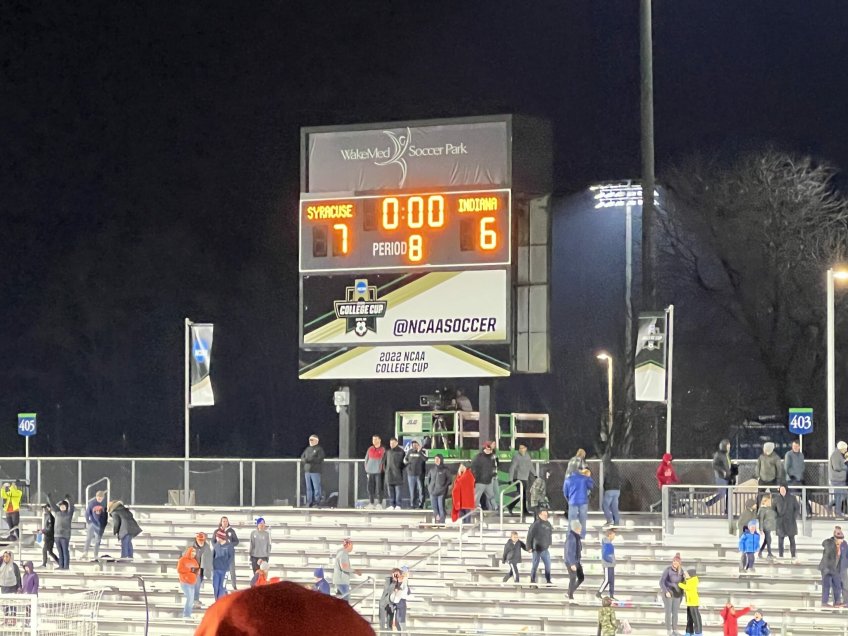
  • CARY, N.C. — In their 50th season, the Indiana University men’s soccer team was 90 minutes away from the perfect ending to the season — a ninth national championship. The…
  • Anyone who watched the Indiana Hoosiers men’s soccer team this season had their doubts. The Hoosiers would come together and play great one minute. And 10-15 minutes later, it…
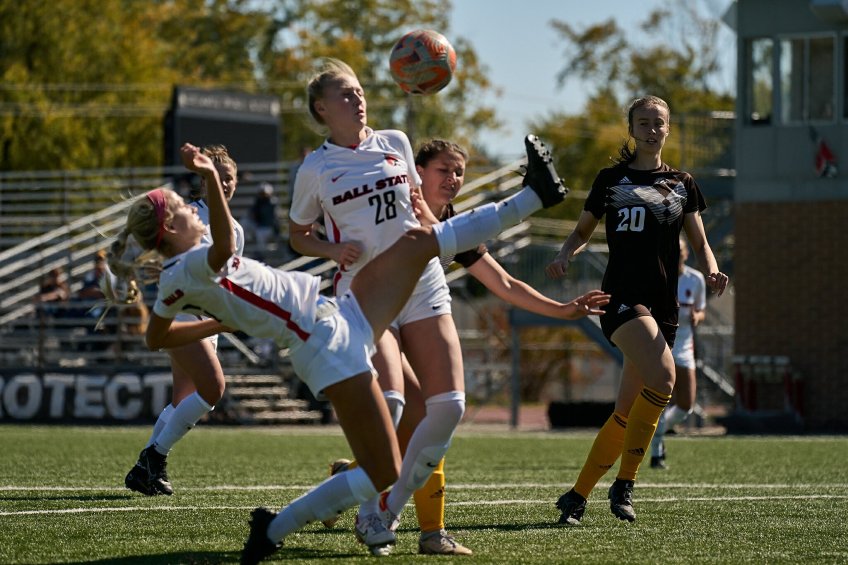
  • MUNCIE, Ind. — Western Michigan cooled off an in-form Ball State squad with a 2-nil road win on Oct. 9. The Cardinals had previously been unbeaten across their last…

Canadian youth international Okello attracting attention from Bundesliga – Soc Takes

Photo credit: Helge Landmann

Noble Okello is a player with an uncertain future. Okello, currently on contract with Toronto FC, is a player Bundesliga club VfL Wolfsburg is interested in acquiring. The 17-year-old has represented Canada at the U-17 level, but is yet to make any impact at the MLS or USL level for Toronto FC.

In spite of this lack of playing time, Okello was invited to train with Wolfsburg in January and impressed the team’s technical staff enough to warrant three transfer bids for the player.

Soc Takes has seen a copy of the third offer for the player and it includes a six-figure transfer fee. The offer also includes appearance fees as well as a sell-on fee. Soc Takes was able to independently verify the authenticity of this contract.

A source informed Soc Takes that the two sides disagreed on whether or not the deal would be permanent; While TFC was only interested in a loan, Wolfsburg was interested in buying the player outright. Wolfsburg’s meet-us-in-the-middle offer to take the player on loan with an option to buy was also rejected.

Soc Takes spoke to Okello’s agent, who claimed the transfer fee being offered was “a six-figure number that would be more than what FIFA would issue as training compensation.” Soc Takes was unable to independently verify this with FIFA.

Based on the rejection of this deal, it is clear that TFC values the player very highly. That valuation, however, is misaligned with the lack of playing time for Okello at either the MLS or USL level.

A spokesperson for Toronto FC confirmed that Okello trained with the German club and that an offer was received, yet did not clarify why the bid was rejected, citing the club’s policy not to publicly discuss such decisions. 

Since Okello’s contract is with TFC II, TFC would be be able to approve or deny transfer deals without the intervention of MLS.

Canada has a rich history of sending players to the Bundesliga. Paul Stalteri, Marcel de Jong and Julian de Guzman all played in the league. Most famously, Calgary-born Owen Hargreaves moved from Canada to the youth academy at Bayern Munich as a 16-year-old, eventually going on to win multiple trophies with the Bundesliga hegemon.

Whether Okello will be allowed to join that illustrious list, or whether he is able to break through at TFC remains to be seen.

Follow Nipun on Twitter: @NipunChopra7.

Support Soc Takes on Patreon for access to exclusive content and supporter benefits. Click here to become a patron today.

Related

USL franchise fees: Shepard tone or sign of progress? – Soc Takes

Whether or not you’ve heard the term, you’ve experienced an example of Shepard tone. Think of the endless stairs in Super Mario 64 or even in the soundtrack of Christopher Nolan films. It is the (auditory) illusion of ascendancy; the feeling that the music is rising in scale, seemingly forever. In reality though, the musical motif is a cheap brilliantly disguised parlor trick. There is apparent ascendancy, but, really, you’re stuck in the same place after eight bars.

As Soc Takes revealed last week, the USL’s expansion fee has risen from $5 million to $7 million. In American sport, the value of a sporting entity is often worth what someone is willing to pay for it. By that argument, the USL is on a strong upward trajectory. But while the (pay)scale does seem to rise, is the league still stuck in the same place?

Quick History

Lower-division soccer in the U.S. was reconfigured in 2009. The United Soccer League (USL) and North American Soccer League (NASL) became separate entities, and it ushered in the latest era of the American “soccerwarz.”

It’s widely known that the NASL experienced a sigmoidal curve of success. Initially promoted to Division II, it secured strong markets such as San Antonio, Tampa, Jacksonville, Miami, Indianapolis, etc. However, by 2015, the tide was turning. The NASL had lost the financial support of Traffic Sports, and the initial defections of Tampa Bay and North Carolina foreshadowed the eventual collapse of the NASL. (For an excellent summary of the “soccerwarz,” read Kartik Krishnaiyer’s “Soccerwarz: Inside America’s Soccer Feud Between MLS, NASL and USL.”)

Meanwhile, the USL, which had for five years remained in the shadow of the glitzy and bombastic NASL, was slowly gathering steam. Per information provided to Soc Takes, the USL was already planning to apply for DII sanctioning as early as 2015. This culminated in a co-awarding of DII sanctioning between the NASL and USL in 2017. By 2018, the USL was sanctioned as the sole DII league in the United States.

Fees

The USL’s upward trajectory is best typified by its consistently rising initial franchise fee. In fact, this rise is truly remarkable.

Per documentation obtained by Soc Takes, these were the USL’s expansion fees starting in 2009:

2009: $750,000 (emergence of the NASL) 2010: $150,000 2011: $250,000 2012: $500,000 2013: $750,000 2014: $2 million 2015: $3 million 2016: N/A (rumored to be $3 million) 2017: $5 million

2018: $7 million

The remarkable rise in the USL’s expansion fees

Within the space of nine years, the initial franchise fee has increased 47-fold. That is remarkable, but this increase cannot be judged in a vacuum. There are many simultaneous events in play, including the aforementioned “promotion” from Division III to II, as well as the demise of market competitors. Here’s more context:

In 1998, the Miami Fusion are believed to have paid $20 million to join MLS. In 2018, FC Cincinnati is believed to have forked out $150 million. That means in 20 years, MLS’ valuation of clubs has risen 7.5-fold. In half that time, the USL’s 47-fold increase has far outpaced even the top professional league in U.S. Soccer.

This clearly indicates that the USL is in demand and, based on the operationally defined metric of expansion franchise valuation, is succeeding. If you want soccer to succeed in America, that’s certainly good news. But it also raises two very central questions: Is the USL making money, and why is the league’s growth out-accelerating even MLS?

Is the USL making money?

Yes, but that wasn’t always the case. Per documentation obtained by Soc Takes, the USL, as a league entity, operated at a net loss between 2009 to 2011. The tide began to turn in 2012, when the USL recorded a profit of $174,522. Since then, the USL has turned over a profit each year. Between 2012-15, the annual profit was six figures. In 2016 and 2017, its net income was $2.42 million and $6.68 million, respectively. Its most profitable year was 2017, and based on multiple expansion announcements, 2018 is likely to be even better.

One misnomer is that the USL collects expansion fees in one lump sum. This notion is fostered by the league’s operational agreement, which suggests that expansion fees are payable as one lump sum at the time of agreement. However, three independent sources confirmed to Soc Takes that expansion franchises usually pay their franchise payments in annual installment payments, per the terms of each franchise’s agreement to join the league. Given that the USL has brought on over 10 new teams in the last couple of years, the league will will reap the benefits — albeit in smaller amounts every year — of that income for years to come.

Improvements

Depending on your own metric, there are other signs of upward progress for the USL.

The USL’s broadcast deal with ESPN+ places the league within the consciousness of American soccer at large; you can fire up your Roku player and see “North Carolina FC vs. Nashville SC” next to the El Trafico derby.

The USL’s media and public relations game is precise and has elevated the lower-division soccer PR in unprecedented ways. FC Cincinnati continues to be one of the best stories of lower-division soccer success. Moreover, with the imminent launch of USLD3 and having potentially secured one of the last bastions of independent soccer, it is clear that the USL is well placed to control non-MLS pro soccer in the U.S. While the NASL’s league office was barebones, the USL’s office in Tampa is constantly expanding and hiring more employees.

Additionally, per documentation, the USL is poised — for the first time in its history — to assist teams with costs associated with broadcasting games, which would be a welcome relief for current owners.

The improvements are not all about business and money either. On the pitch, the USL’s standard of play has improved. I do not have metrics on this, more my subjective opinion based on watching the league between 2016 and 2018. Louisville City FC (last season) and FC Cincinnati (this season) are two of the stronger lower-division teams assembled in recent history. Additionally, goals from USL games regularly feature on ESPN SportsCenter, highlighting at the very least, improved technical ability of outfield players.

Player wages

But, are those technically superior players being paid better? Sort of.

Based on documentation obtained by Soc Takes, while the total expected expenditures for a new USL team were between $1.1 million to $1.5 million in 2012, the total expected expenditures skyrocketed to between $10.6 million to $15.8 million in 2018, a 10-fold increase. Yet, the total expected player salaries per club only increased from $150,000-$200,000 in 2012 (when the USL was third division) to $250,000-$500,000 in 2018, an increase of 2.5-fold at the upper end. So, while owners are forking exponentially increasing expenditures, that money isn’t going toward players at the same level of increase.

Click here for information on expected expenditure for first-year USL owners.

According to USL documentation, the current expected initial investment by a new team is at least $10.6 million (including a $7 million expansion fee). That investment comes in the face of lower-division soccer teams and owners struggling to survive. (Since the publishing of our previous story on this subject, additional USL owners have confirmed the magnitude of annual losses experienced.)

Per the aforementioned documentation, 12 USL-aligned franchises (including the PDL) were terminated in 2017. While the identity of those teams remains unclear, one is believed to be the Rochester Rhinos and the other two are believed to be Vancouver Whitecaps 2 and Orlando City B. Meanwhile, the Harrisburg City Islanders, under new ownership, rebranded as Penn FC.

WTF lads

That brings us to the second question raised by the unquestionable growth of USL valuation. WTF? Except in this case, the ‘W’ stands for “Why.” Perhaps they simply love the sport. And that certainly has a big part in it. But, romanticism notwithstanding — given these owners are also successful businessmen — it still remains confusing.

What is so attractive about the USL that it seduces owners to act against historical financial data and personal financial interests (at least in the short-term)? After all, the league is not misrepresenting the financial hole owners will find themselves in (see table).

Is the USL creating an illusion of artificial scarcity? It is reasonable to believe that with the purported end of MLS expansion, the USL will become the biggest game in town. Therefore, owners believe that this acceleration of USL expansion fees is only headed skyward. This would make financial sense — an owner who spent $500,000 in 2012 could make potentially serious money if the USL’s expansion fees continue to head upward by selling the franchise to another investor.

The USL’s Shepard tone (Credit: @Jeremyya on Twitter).

In an excellent interview conducted by WRALSportsFan’s Neil Morris, USL president Jake Edwards suggested that USL (DII) expansion is about to cessate. “There is a finite number, really,” Edwards said. “We don’t put a hard cap on that, but I would imagine it would be somewhere in the high 30s.”

If true, interested investors may feel under pressure to seek a USL franchise. However, that is contingent on the clockwise rotation of the MLS spigot. If MLS continues to expand beyond its current aspirations, the USL potentially becomes a less interesting commodity.

And, even if the spigot does finally tighten all the way, will “MLS dreamers” — owners in the USL who are simply biding time to get an MLS spot — get disillusioned at the lack of potential for upward mobility? Perhaps they will walk away.

So, regardless of whether MLS curbs expansion, there may yet be an efflux of USL owners depending on their initial goal for investing.

Another potential reason for increasing USL’s valuation may be an attempt by USL to redirect interested owners into joining USLD3. Per documentation provided to Soc Takes last year, the initial expansion fee for USLD3 is $500,000, certainly far more affordable than the USL’s $7 million. In turn, USLD3 might be able to increase its own franchise fee at a rate consistent with the USL’s. USLD3 needs eight teams to apply for Division III sanctioning. Currently, the league has five announced teams.

Problems

There are potential hurdles ahead for the USL. One is that a number of teams may soon have a get-out-of-jail-free clause.

Many of the early USL clubs signed a five-year franchise agreement with the league. That five-year term, depending on the club, may expire at the end of this year or next (Soc Takes was able to confirm this clause with two existing USL owners). This would allow those franchises to exit the league without paying an exit fee — close up shop, cut their losses and put their money in a sure shot investment, like a Marouane Fellaini jersey.

A sureshot investment. (Credit: Man United store)

However, the USL, having recognized this potential problem, started instituting measures in 2016 to incentivize owners to remain in the league. The increased expansion fees was one, while another is a meager fee of $10,000 to re-up for another term. Oh, and this time, the new term is for 10 years.

While the USL has been turning out a yearly profit, now in the millions of dollars, some of that money is being diverted — at a rate of 3.5 percent of annual income — to investors and partners in NuRock holdings. The USL’s 10-year contract with NuRock’s Management and consulting branch expires at the end of the 2019 season, but could be extended for another five years. This does not seemingly affect the ownership of USL, which NuRock Soccer Holdings, LLC still controls at 99% (with Robert Hoskins owning the other 1%).

(UPDATE July 31st, 1030AM: Soc Takes was informed by readers that this was unclear, so the statement about NuRock was clarified. The clarified portion is italicized)

While the USL is currently winning the “soccerwarz,” independent soccer has not disappeared. There are continued conversations regarding NPSL Pro and NISA. Additionally, the potential outcomes of lawsuits involving NASL entities, if successful, would result in the dissolution of professional standards; this would destabilize the USL and MLS in significant ways. For one, it would immediately remove the illusion of artificial scarcity.

(*For excellent coverage of these lawsuits, check out Miki Turner’s articles over at Soccer ESQ.)

Conclusion

There are certainly strong signs of upward mobility for the USL, and in the difficult atmosphere of lower-division soccer, that needs to be appreciated and admired. The USL has already exceeded what the NASL was able to achieve in terms of the league’s financial stability, franchise longevity and measured expansion.

But, concerns remain over the long-term future of the USL. As the league embarks on populating another league of committed owners, it is unclear why those owners continue to invest and hemorrhage money. While the league has created a scenario where increasing expansion fees is possible, all of it may yet sit upon a house of cards, one that — pending a court decision, the no-penalty exit of USL owners due to term expiration or changes in MLS’ expansion processes — may slowly collapse like the upper octave of a Shepard tone.

WRALSportsFan’s Neil Morris contributed to this report.

Follow Nipun on Twitter: NipunChopra7.

Support Soc Takes on Patreon for access to exclusive content and supporter benefits. Click here to become a patron today.

Related

HOME Archives – Page 2 of 72 – Soc Takes

  • INDIANAPOLIS — Butler hosted Ball State at the Sellick Bowl on Thursday, and the visiting Cardinals rebounded from a 2-nil deficit to earn a 2-2 draw against the Bulldogs. Katie Soderstrom produced both tallies for Butler before Ball State answered through Avery Fenchel and Sammi Corcoran. Follow Robbie on…
  • INDIANAPOLIS — A high-scoring affair between the Indy Eleven and Birmingham Legion FC culminated in a 4-3 Indy victory Saturday evening at Carroll Stadium. Stefano Pinho’s 78-minute tally broke the tie after previous goals by Indy’s Neveal Hackshaw (2) and Juan Tejada, and Birmingham’s Enzo Martinez and Marlon Santos…
  • MUNCIE, Ind. — Ball State blanked Valparaiso 3-0 behind two goals from Avery Fenchel and a third from Delaney Caldwell on Sunday afternoon, a day in which the Cardinals celebrated Senior Day. Follow Robbie on Twitter: @RobbieMeh. Support Soc Takes on Patreon for access to exclusive content and supporter benefits. Click…
  • INDIANAPOLIS — Days after stunning Western Conference-leading San Antonio FC, the resurgent Indy Eleven knocked off Eastern Conference rival and first-place Louisville City FC 2-1 on Wednesday at Carroll Stadium. A brace by Stefano Pinho brought Indy back from 1-0 down after an early goal by LouCity’s Ray Serrano….
  • MUNCIE, Ind. — The Xavier women’s soccer team moved its record to 3W-1D-0L over the weekend with a high-scoring 4-2 victory at Ball State. Follow Robbie on Twitter: @RobbieMeh. Support Soc Takes on Patreon for access to exclusive content and supporter benefits. Click here to become a patron today….
  • INDIANAPOLIS — The Indy Eleven ended their recent run of poor form Saturday with a 1-0 win over league-leading San Antonio FC. SAFC entered with 57 points, the most in the USL Championship, and has already clinched a playoff spot. Follow Robbie on Twitter: @RobbieMeh. Support Soc Takes on Patreon…
  • LOUISVILLE, Ky. — Goals by Sophia Smith and Hina Sugita helped the Portland Thorns to a 2-1 road win over Racing Louisville on Friday at Lynn Family Stadium. Alex Chidiac provided the lone tally for the hosts. Follow Robbie on Twitter: @RobbieMeh. Support Soc Takes on Patreon for access to…
  • FORT WAYNE, Ind. — Fort Wayne FC shut out the visiting Cleveland Force 3-0 on Saturday behind a brace by Maxwell Amoako and an own goal by Cleveland goalkeeper Andrew Cooke. Follow Robbie on Twitter: @RobbieMeh. Support Soc Takes on Patreon for access to exclusive content and supporter benefits. Click here to…
  • INDIANAPOLIS — Playing in its first game at Carroll Stadium, the Indy Eleven women wrapped up an undefeated USL W League regular season with a 3-0 win Saturday against Detroit City FC. In the nightcap, the DCFC men’s side bested Indy 1-0 in USL Championship play. Follow Robbie on…
  • LOUISVILLE, Ky. — Goals by Paige Monaghan and Taylor Smith helped lead Gotham FC to a 2-1 road win at Racing Louisville on Friday. Savannah DeMelo provided the lone tally for the hosts. Follow Robbie on Twitter: @RobbieMeh. Support Soc Takes on Patreon for access to exclusive content and supporter…
  • PITTSBURGH — Albert Dikwa’s volley in the 79th minute Wednesday delivered the Pittsburgh Riverhounds a 1-nil victory over the visiting Indy Eleven at Highmark Stadium. Follow Robbie on Twitter: @RobbieMeh. Support Soc Takes on Patreon for access to exclusive content and supporter benefits. Click here to become a patron today….
  • NASHVILLE, Tenn. — The visiting Portland Timbers rallied from 2-nil down to draw Nashville SC 2-2 on Sunday at Nissan Stadium. Goals by Nashville’s Sean Davis and Hany Mukhtar were canceled out by strikes from Dairon Asprilla and Jaroslaw Niezgoda. Follow Robbie on Twitter: @RobbieMeh. Support Soc Takes on Patreon…

ownership Archives – Soc Takes

  • Whether or not you’ve heard the term, you’ve experienced an example of Shepard tone. Think of the endless stairs in Super Mario 64 or even in the soundtrack of Christopher Nolan films. It is the (auditory) illusion of ascendancy; the feeling that the music is rising in scale, seemingly…
  • The lower divisions of American soccer are a tumultuous place. Whether it is the collapse of individual clubs, irresponsible behavior toward players or the death of an entire league, the stories of instability are as commonplace as a PBR at your local dive bar. Yet, there is one narrative…