Exclusive Q&A with 'Tubthumping' Tommy Heinemann – Soc Takes

Photo credit: Tommy Heinemann

Tommy Heinemann has endured a difficult year. From the highs of winning the NASL and signing a contract with FC Cincinnati, to the lows of the events of early January and beyond. On Nov. 15, Heinemann’s agent, PJ Savage, confirmed via Twitter that Heinemann won his arbitration case against FC Cincinnati. Through all of it — and in the face of unfair criticism from a small section of the FC Cincinnati community — Heinemann chose to maintain his silence.

But, he deserves to have a voice now.

In an exclusive interview with Soc Takes, Heinemann discussed the events and the aftermath of his exit from FC Cincinnati. While he was noticeably reticent to discuss details about remediation, Heinemann discussed the controversy surrounding the injury.

Soc Takes has previously discussed the merits of Heinemann’s claim, and it should be noted that both the USL as well as the arbiter voted in Heinemann’s favor.

Heinemann’s faith and family are the core around which he has built his Tubthumping-esque approach to life. Most of all, Tommy reminds us that there is a person (and a family) behind a number.

And that you truly cannot keep a good man down.

Nipun Chopra: How are you feeling now that this ordeal is over?

Tommy Heinemann: I’m very grateful for a number of reasons. First of all, that I serve a faithful God. Secondly, that I have a loving wife and family that stands by me in every single moment. Thirdly, I have a loyal agent and friends across the soccer community who have stood by me. To be able to have this outcome of the arbitrator holding up my contract is something that I trusted God would happen the entire time. It wasn’t easy though, it’s been a difficult 11 months. Sometimes people were flinging all types of things at me. I tried to walk the line — I don’t bash other people — but i must stand for the truth. The truth shines through and that’s the most rewarding thing.

NC: Your religious faith has been very important to you. Tell us why.

TH: I gave my life to Christ when I was 8 years old. It wasn’t until I was in middle school that I started understanding that to proclaim to know God, I was called to walk and talk in the manner He calls me to. I was cut by both my club team and my varsity high school soccer team. In 2004, my junior year of high school, I had my first ACL surgery and missed my senior year of high school.  I desperately wanted to play soccer, and through prayer and trust in God, I felt God leading me to Rockhurst University where I walked on. My first year, I was just happy to  earn the opportunity to wear the jersey. My first game at Rockhurst I started on the bench, but came in and scored two goals and an assist. I started every game except one my freshman year and eventually, I joined a PDL team in St. Louis, the St. Louis Lions. I scored eight goals in my first eight games, and tore my ACL again in 2006. By the grace of God, I rehabbed and became a two-time All-American at Rockhurst and completed two more years with the St. Louis Lions finishing with 35 goals in 36 games. Through these trialing experiences God taught me first-hand about His faithfulness. He taught me that He is sovereign, and no matter the circumstance, He is in control and to trust in Him. Throughout my entire career, His faithfulness is evident and it’s only by his grace that I am able to play the game I love. That’s why it is so important to me.

NC: Was that injury your last knee surgery?

TH: My last knee surgery was in 2012. It was a microfracture surgery. My last ACL surgery was in 2006.

NC: Going back to your faith, how does one have all these horrendous injuries, and still manage to retain their faith?

TH: Inevitable, we are human and doubt does creep in and present itself, but God’s word never returns void. It’s difficult at times to trust, but I have to daily depend on God for physical strength, emotional strength and spiritual strength. It’s a big part of me as a person.

NC: Can you summarize the events that lead to your exit from the club?

TH: I signed a contract with FC Cincinnati on Nov. 20, 2017. My contract became effective on Jan. 1, 2018.  I arrived in Cincinnati on Jan. 5 with my wife and 3-year-old son. We signed a 12-month lease on Jan. 13 and I reported to the first day of preseason on Jan. 15. On Jan. 16, I went through a very rigorous physical examination. The first day of training was on Jan. 17, in which I trained and felt great. On Jan. 18, I was told by the club that I had a 95 percent torn ACL. I found this most disturbing and surprising, as my knee felt fine. In seeking my own medical opinion from Dr. Michael Burns in St. Louis, he found my knee to be stable and did not see any problems precluding me from playing. After returning to Cincinnati, the club asked me to accept only a portion of the guaranteed money of my contract, with the other portion conditioned upon the health of my knee and hips. I declined this offer and subsequently received a motion to void my contract from the club on Jan. 30, 2018.

NC: Were you injured at the time of termination of your contract?

TH: No, I was not injured. I was fit, healthy and ready to play. I trained with FC Cincinnati on Jan. 17 and was prepared to continue training.

NC: What was the remedial ruling?

TH: The arbiter ruled to uphold my contract.

NC: Does that mean they are required to pay your contract in its entirety?

TH: For 2018, they upheld my contract.

NC: What about paying your legal fees?

TH: They upheld the contract.

NC: Is this the final step to the best of your understanding?

TH: Yes.

NC: Do you think FCC is going to appeal this decision?

TH: No. (Note: An FC Cincinnati spokesperson confirmed via email that they would not seek further legal options.)

NC: Why did FCC think they would win?

TH: Good question and one I’ve been trying to figure out for some time now. There was an exit physical I had at San Francisco, where the doctor cited a sore groin from the championship game, which was 24 hours before the exit physical. I believe they thought they could use this to get out of the contract.

NC: Have you had any contact with FCC personnel since this came out?

TH: Other than at the arbitration, the last time I spoke to someone at the club was Jan. 30, 2018.

NC: What would you say to those who cite your limited appearances with Penn FC as evidence that you were carrying an injury?

TH: I would encourage those people to get the correct information before they comment. The injuries I incurred after leaving Cincinnati are not relevant to my time in Cincinnati, but rather a normal part of sports. I missed time in 2018 for a few reasons. I sprained my ankle during the first few minutes of one match. I also missed time due to a strained hamstring. I had to miss more time with Penn FC for a few personal reasons, including traveling multiple times for both a deposition and the arbitration hearings which contractually had to be held in Cincinnati. Most importantly, I did not miss a single game due to my knee.

NC: How has this been for your family?

TH: I don’t know if there’s a word that can explain how difficult it’s been. Katrina and I signed for San Francisco  Deltas, we had a great year and won a championship. It was an extremely memorable year. Eight days after the season ended, we signed a contract, uprooted our lives, and moved to a new city (Cincinnati). We signed a new lease and we were prepared to be there for a while.

Two weeks later, we were blindsided. Look, we know this is professional sports, so this is the reality. But, it’s been a difficult year. It’s one that I couldn’t have got through without my wife Katrina. She’s my angel, to steady me, to keep me calm, to keep me composed. Our little guy Hudson has been a healthy distraction.

NC: How old is Hudson?

Photo credit: Tommy Heinemann

TH: He’s three-and-a-half.

NC: How much does Hudson understand about what his father does?

TH: This year more than ever, he knows about what his dad does. Almost every day, he wants to put on the jersey and run around the house. He’s all left-footed (laughs). He loves watching and playing. After every game he asks me, “Papa, will you play with me?”

NC: And does he have a full-beard yet?

TH: (laughs) No, but he does have a lot of hair.

NC: What about your wife? Have the events of this year jaded her from the life of professional soccer?

TH: Here’s the incredible thing — even after all this, she wants me to do what makes me happy. She is the most supportive, most incredible person I know.

NC: You’ve had a lot of support from other professional players as well as the MLS Players Union. What’s that been like?

TH: It’s meant the world. Players more than anyone understand. They have been there, experienced or seen similar things and — especially those with families — they know. Players know what it’s like to play in the lower divisions of U.S. Soccer, to fight, to grind. Guys who have been vocal, and others who have sent me messages, or talked to me in person. The support of the players across the country means the world.

The MLSPA’s support of me, and all players, is absolutely incredible. They deal with the protection of players, so they understand that us players are more than numbers on a board. We are people with families. Their support has meant a lot to my family and I.

NC: What’s the next step for you with Penn FC dropping down to Division III?

TH: It’s a fluid situation; which I’ve become accustomed to (laughs). I’m still working through it.

NC: Will we see you playing next year?

TH: I want to play as long as I can, but I know I can’t play forever. That said, I’m very passionate about coaching, leading and impacting as well. I’ve wanted to become a coach since I was 24. I’ve been preparing for that too.

NC: If this is the end of your career, how will you remember your career?

TH: I will remember God’s continuous faithfulness. I was a kid who was cut from high school, walked on in college. And everything I have is by the grace of God. Everyday I lace up my boots is from the grace of God. Whether the circumstances were excellent or poor, the tide was high or low, my foundation is in Christ and I will always remember His strength in my weakness. A part of each championship, every friendship with teammates and coaches, all the time spent training and preparing, every good time and bad time, God’s faithfulness is what I will always remember above all.

Note: FC Cincinnati provided Soc Takes with the following statement:

“We accept the ruling of the arbiter. We said back in the spring that we would pursue every available opportunity to defend our position, and arbitration was the final step allowed in all USL contracts. Now that the arbiter has issued his ruling, we wish Tommy all the best fortune in his career as we continue our efforts toward preparing for our first MLS season.”

The lower divisions of soccer are a complicated place for professional soccer players. While players are happy to have a place to follow their dreams, those players are often subject to low wages and a significant imbalance in power. Players I speak to often refer to these problems as “necessary evils.”

The fact that the USL and an independent arbiter upheld Tommy’s contract is significant as it shows that the league and the law will uphold player contracts. Perhaps this is a beginning of a necessary fight against necessary evils.

Follow Nipun on Twitter: @NipunChopra7.

Support Soc Takes on Patreon for access to exclusive content and supporter benefits. Click here to become a patron today.

Opinion: Let's pump brakes on return to play – Soc Takes

Are we ready to return to play? I’m sorry, but we are not. Not even close.

Photo credit: Robbie Mehling/Soc Takes

It feels as though it has been years since I watched Tyler Pasher terrorize Tim Howard in Indy Eleven’s away win against Memphis 901. Since then, U.S. Soccer has come to a complete standstill.

The impact of COVID-19 has been global, and the number of cases and deaths in the United States have been remarkable. Currently, over a quarter of the world’s cases and deaths have occurred in America. The impact on global and local economies has been catastrophic and a fifth of Americans currently find themselves unemployed.

One of many economies struck by the pandemic is professional sport, and particularly my favorite niche, professional soccer. Leagues all across the world have rightly canceled matches and training over the past two months, but are now exploring resuming sporting activities. In England, suggestions are that the Premier League may resume in early June, even though it must be noted that mother nature was so upset at the idea of a Liverpool Premier League win, that she imparted a global pandemic upon us.

Closer to home, Major League Soccer (MLS) and the United Soccer League (USL) are all beginning to explore a return to training, while the professional National Independent Soccer Association (NISA) and multiple amateur leagues have suspended play for the spring season.

But should we start playing soccer?

While there has been no statistical analysis of this yet, the downturn in the economy is undoubtedly negatively affecting club finances. Based on the financial instability of American club soccer — even before the pandemic — it is likely that we stumble to the other side of this thing with more defunct clubs and more irresponsible behavior directed toward players and staff. The latest example of this will be possible cuts to player salaries.

So, in the unfortunate roller coaster that is American soccer, financial implications demand a return to play. And, likely, a return to play that includes incorporation of supporters. Unlike the financial behemoths of England, Spain, etc., which can account for sponsorships and TV revenue as a significant portion of club income, American soccer continues to rely heavily on ticket revenue to remain financially solvent.

In other words, the ecosystem of players, technical and non-technical staff, referees, administrators, vendors, etc. need the game to return at some point. Fans, too, need a distraction from the terrifying reality of the world around us.

But are we ready to return to play? I’m sorry, but we are not. Not even close.

In order to return to play, we must be able to test players regularly. How regularly? Every day. Every day that they train and/or play a game. Can we achieve this?  We — and I cannot stress this enough — cannot.  Harvard Global Health Institute analyzed that the country should be conducting approximately 900,000 tests every day by May 15th. Our current rate of testing is far short of that at around 350,000 tests. So, even in a best case scenario, we are not close to our testing goal.

Beyond that, there are significant ethical considerations to prioritizing testing professional athletes over healthcare personnel, the elderly and other at-risk populations.

But, let’s assume that we do get to a panacea that allows for us testing everyone. There are two more things we should consider: a methodological and epidemiological concern about testing.

The first has to do with the test itself. You see, there are two ways we are testing for COVID-19. The first and most common test is a Reverse Transcriptase-Polymerase Chain Reaction (RT-PCR)-based test. That’s a fancy way of saying: It is a test for presence/absence of viral particles in a patient’s blood. The other, the antibody test, looks for signs of a patient’s immune response to the virus, and is therefore an indirect measure of infection.

To put it simply, the former allows you to test for current infections more accurately. The latter — depending on the type of immunoglobulin (A flag your immune cells produce in response to infection) being tested — can affirm current or previous infections.

Here’s the kicker. Neither test is perfectly accurate. The current estimate for the RT-PCR (viral-particle)-based test suggests that it inaccurately diagnoses between 10-20% of tested individuals as COVID-19 free. Other tests can be less accurate.

Using those statistics in an overly simplistic way, that means that if we test our 10 outfield players — let’s ignore goalkeepers because they don’t really matter — it is possible we misdiagnose one of them as being COVID-19 free when they are not.

The assumption above is that all 10 players are COVID-19 positive, so it is far from a perfect illustration and forgive me the imperfect analogy. The key is to understand that with a big enough population, this false negative will eventually manifest. If we test every player, every day, this will manifest. Given the close quarters professional athletes find themselves in — locker rooms, hotel rooms, contact on the field, etc. — this could be the beginning of a focal breakout.

A focal breakout, where a potentially asymptomatic individual infects multiple other people during a training session or a game.

Does either league have a plan for this scenario? Or are we in – “let’s figure it out later” mode?

As a proof of concept, the CDC reported a scenario where one individual infected multiple other individuals during a 2.5-hour choir rehearsal. While I don’t anticipate watching Bastian Schweinsteiger and Mark-Anthony Kaye singing harmony on “Bridge over Troubled Waters,” anytime soon, the same issue of close contact during a soccer game presents potential superspreader risk.

The second problem with the testing is the latency period of the virus. Let’s return to our current scenario of testing, where people are being tested when they start to show symptoms. To put it simply, if you are exposed to the virus on May 12, it is likely that you will show symptoms by May 15. But, it may be between 1-24 days until you show symptoms.

And, as many of you know by now, it is possible that that player can spread the virus during that time.

So, please, I implore you, we are not ready.

One commonly cited method of returning to professional support envisions a scenario where players are sequestered from the outside world. They live in hotels, do not physically interact with their families, and simply train and play football. 

In premise, this seems reasonable. But, how realistic is it in practice? Sure, we can sequester players in a hotel. But, what about coaches? Sure, let’s throw them in there, too. What about referees? Alright, get Howard Webb the presidential suite at the Ritz Carlton. Sorted. Ummm… what about non-technical staff who interact with players? What about hotel workers? What about the mental toll of separating players from their families during a global pandemic?

Sure, if the question is: Would a player accept being separated from his family over not getting paid? The answer is likely “yes.” But, I implore you to recognize that the problem is THAT question.

The question should be – “How dare a millionaire or billionaire ask a player to decide between his health (and that of his loved ones) or a paycheck?”

And how dare Major League Soccer and United Soccer League – who will continue to generate revenue – allow owners to do so?

So, please, I implore you, we are not ready.

Let’s take a hypothetical scenario. We restart MLS/USL seasons. All goes well for the first couple of game days. Indy Eleven is top of the table, per usual. Players are enjoying their hotels, spending their time playing video games, eating delicious lasagna at the hotel and FaceTiming with their loved ones. But then, it happens. (And it undoubtedly will at some point.)

One of the players tests positive for COVID-19.

What’s the plan? If you are an MLS player, you’re covered by medical insurance. If you’re a player in the USL, are you paying out of pocket in absence of medical insurance?

OK, let’s look past the uncomfortable reality of player insurance that we all like to avoid. Let’s look at logistics. In terms of logistics, quarantining the player is the easy part. Who else gets quarantined? His roommate? Easy. Check. Every person he has interacted with? Yeah, probably. Since everyone is coexisting in a hotel, that means the entire team. Players, technical staff, everyone.

So, please, I implore you, we are not ready.

I know, I know. I’m a complainer not a doer. It’s easy for me to point out the problems and not give you a solution.

And, you know what, I’m fine with that characterization. Because, the only solution right now is — we need more time. We all do. We are in the middle of an unprecedented pandemic that is evolving before our eyes. We are still understanding the scientific mechanisms, spread (have we considered the possibility of a soccer ball as a disease vector?), evolution and the likelihood of a second wave. In the absence of achieving an estimated 70% recovery-contingent herd immunity, we must wait. We must wait for access to a reliable and safe treatment modality. Ideally, we must wait on a vaccine.

So yes, there are significant financial implications at stake. But, the burden of those questions SHOULD be on MLS and USL owners. Those owners should not be placing the health of their employees over their own short-term financial stability.

While I don’t have clear-cut solutions other than “more time,” I know what isn’t a responsible decision — players should not face salary cuts. Whether owners have to take short-term hits, this is what they signed up for. In an environment where lower-division soccer players are paid low wages and occasionally don’t have medical insurance, truncating their salaries is unacceptable.

Across the country, states are reopening businesses as the scientific consensus has taken a backseat to right-leaning politicking. As a soccer community, let’s not make the same mistake.

I implore you, we are not ready.

Follow Nipun on Twitter: @NipunChopra7.

Support Soc Takes on Patreon for access to exclusive content and supporter benefits. Click here to become a patron today.

Interview with PRO Referees – Soc Takes

Credit: PRO Referees

In response to Soc Takes’ recent article on referee assessment, we were contacted by PRO Referees to further expand on the refereeing conversation. Soc Takes also spoke to PRO general manager Howard Webb – arguably one of the best known retired referees worldwide – about USL’s role in the institution of Video Assistant Referee (VAR).

(Note: This interview has been edited for clarity.)

  1. How many total registered referees are there in America. How many referee assessors/coaches are there?

According to U.S. Soccer’s records:

Number of registered referees for 2018: 138,891

Number of assessors for 2018: 1,303

Number of instructors and National Referee Coaches in 2018

Instructors/State Instructors: 1,691

National Referee Coaches: 112

  1. How many referees are there at the various grade levels in the United States.

Grade 1: 8

Grade 2: 16

Grade 3: 58

Grade 4: 70

Grade 5: 213

Grade 6: 1,615

Grade 7: 11,190

Grade 8: 125,721

  1. What is the defined role of PRO?

Who We Are

The Professional Referee Organization is an independent company responsible for administering professional referee programs in North America.

What We Do

We are dedicated to the identification, training, assessment, assignment, and employment of male and female professional soccer officials. We provide our services to North American professional soccer leagues, CONCACAF and FIFA competitions.

PRO Mission Statement

To supply World Class Match Officials for all professional soccer in North America.

PRO Vision

To become the example for World Class soccer officials by 2022.

  1. While I was able to get a pretty good understanding of it via talking to referees, could you, from PRO’s perspective, explain the requirements of the “grade sheet”. Specifically, how positive points/negative points are awarded to referees based on their performance in a game. I understand, it starts at 81, and you get points deducted for incorrect decisions that affect the game. How subjective is that evaluation?

Our assessment program is based on 2 main sections:  1) Overall performance, and 2) Key Match Incidents (KMIs).  Overall performance consists of position-specific competencies and behaviors, with six main categories for Referees: Match control, Player management, Game management, Teamwork, Positioning, and Movement. Assistant Referees are evaluated on four main categories:  Offside, Involvement and Assistance, Positioning, and Movement.

Fourth officials are evaluated on Management of the technical areas and Assistance to the referee team.  Officials can earn additional points if they perform better than a good-acceptable level.

Outside those categories, we focus on Key Match Incidents (KMIs) e.g. penalty kick, send off, offside for goals or obvious goal-scoring situations. Incorrect key match incidents (i.e. incorrectly given or missed) will lower an official’s grade to varying degrees depending on the difficulty of the decision. The base score for working to PRO’s good-acceptable performance in a standard difficulty match is 82. Officials can also benefit when a game is ranked challenging or very challenging in difficulty. They will start at a higher base score in those matches.

  1. How are referees trained to handle the myriad of criticism that is sent their way after virtually every game?

What we are telling our officials is to analyze the game they just officiated and write a self-evaluation that is reviewed with their coach. After these reviews and learning points are accepted, it’s important to set this game aside and move on with a fresh mind to their next assignment. Bringing your mistakes with you when officiating your next game never works well, just as players do not perform well in their next game if they linger and dwell on past mistakes.

PRO has also provided our officials with access to a sport psychologist who helps them deal with various stressors they encounter pre- and post-match, including public criticism.

It is easy to have an opinion and even easier to express that opinion in today’s environment, but it is the officials who have put in the time to hone their craft and deliver games week in and week out that are putting themselves on the front lines.  Knowing that gap exists between general opinion and actually doing the job every week helps put that criticism in perspective.

  1. there are many fans and journalists who believe referees should have to explain their decisions to the public after games. What is PRO’s reaction to that?

You can find pros and cons when thinking about this idea. While senior officials may be better equipped to handle the media following games given the right training, it is a different situation when it comes to young, upcoming officials from the PRO Development Group. They are just becoming accustomed to officiating in a much more public light given all the social media scrutiny, but having to explain decisions after games to the public carries a much bigger burden that starts to come away from explaining decisions from a basis of Law and more towards being put “on trial” for decisions that will very often be subjective in nature.

There are already processes in place that allow pool reporters to ask questions directly to the officials, which provides the public some understanding about why a particular decision was made from a Law perspective.

  1. Is there truly a referee shortage in America? And what steps is PRO taking to address this issue?

The referee shortage across sports in the U.S. is well known, with the root causes being similar in soccer as in other sports. The retention of young officials due to a lack of sportsmanship from parents, coaches, and players has been identified across sports as a major issue, leading to upwards of 50% turnover after the first or second years of officiating.

It is difficult to provide continuing education to advance officials when training and development resources must be focused disproportionately on entry levels over time.  When the number of teams, leagues, and matches at all levels continues to grow at a high rate, but the rate of officials staying involved stagnates, a gap develops very quickly.  We know from officiating surveys that quality mentoring is a major component of retention.  U.S. Soccer works diligently to provide guidance and education to member states to implement high quality mentoring programs, and PRO supports these efforts wherever possible with both our staff and active officials.

  1. What is the relationship between referee coaches from PRO v LACs assigned by US soccer?

The National Assignors (they are no longer called “LACs”) are very important to PRO as we rely on them to provide quality officials for some positions in the leagues that PRO services, particularly when there are limited travel budgets, last-minute replacements are required due to travel disruptions, or our PRO pool is stretched thin in certain weeks of high volume.

PRO referee coaches have often worked with National Assignors in the past (for example as officiating colleagues) so there is a healthy network of familiar faces to help identify upcoming talent and ensure opportunities exist for that talent to start down the path of working professional games.  The PRO Development Group Assignor Assistant, Brenda Wright, is in constant contact with National Assignors to help facilitate a cooperative environment and coordinate assignments that keep the pipeline fresh.

——-x ———-

Howard Webb. Credit: Goal.com

Conversation with Howard Webb: 

In your interview with Grant Wahl a year ago, you discussed how VAR was trialed in the USL. Can you comment on some of the lessons learned during that time, and whether the league was easy to work with? 

We have an excellent working relationship with USL and it’s Senior Management Team. The opportunity to test Video Review in competitive games, played within stadia with fans in attendance, was vitally important in familiarizing our officials in correct use of the VAR protocol and procedures, in understanding the logistical requirements in-venue to make Video Review run smoothly and efficiently, and in assisting us to understanding the best way of ensuring the various stakeholders were kept informed of proceedings.

Could PRO comment on whether VAR – which was tried out in the USL – will be used in the league in the future? 

That’s ultimately a decision for USL. However, I would like to acknowledge USL’s contribution to the successful implementation of VAR in North America…the league played an important part in the testing of the system in 2016 and the early part of 2017.

(Soc Takes reached out to USL on October 15th to determine whether the league was interested in re-introducing VAR in the future. The league had not responded at the time of publishing).

Follow Nipun on Twitter: NipunChopra7.

Support Soc Takes on Patreon for access to exclusive content and supporter benefits. Click here to become a patron today.

Video: Roar of 30K FC Cincinnati supporters at Nippert Stadium – Soc Takes

  • Well, hello there, SocTakes crowd. Remember me? It’s been a while. Even longer than before. Sorry about that, the pandemic, and life, and the universe, and everything, it all…
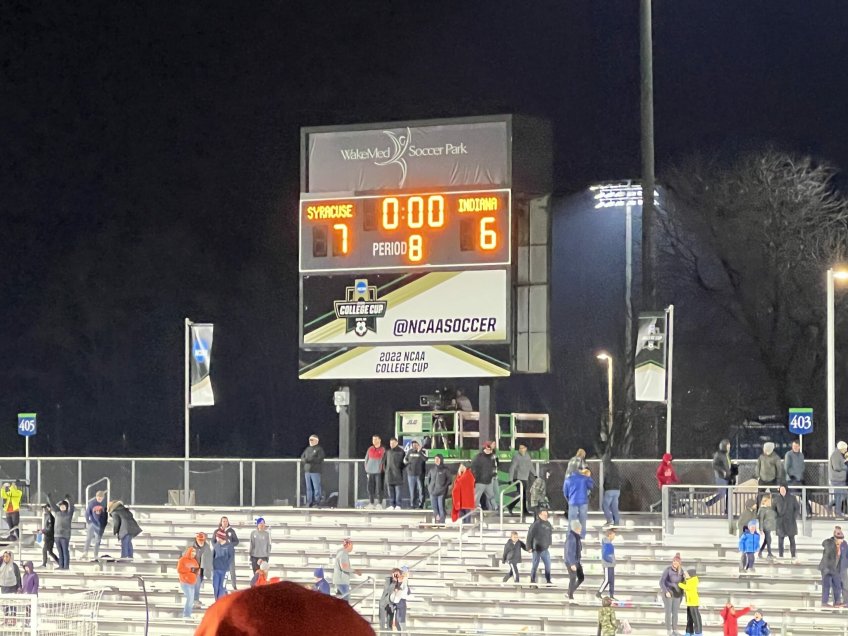
  • CARY, N.C. — In their 50th season, the Indiana University men’s soccer team was 90 minutes away from the perfect ending to the season — a ninth national championship. The…
  • Anyone who watched the Indiana Hoosiers men’s soccer team this season had their doubts. The Hoosiers would come together and play great one minute. And 10-15 minutes later, it…
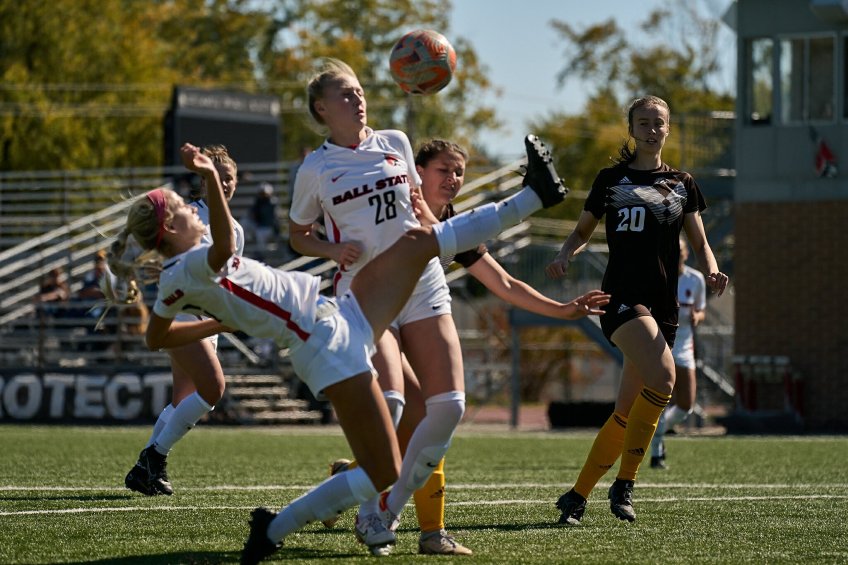
  • MUNCIE, Ind. — Western Michigan cooled off an in-form Ball State squad with a 2-nil road win on Oct. 9. The Cardinals had previously been unbeaten across their last…